White Papers & Articles
Related white papers and articles for AI Agent Development will appear here as they're published.
View MoreAI Agent Development
Which makes the model the easy part. We build agents that know what they are allowed to touch, stop and ask when the stakes are high, and leave a trail you can read afterwards.
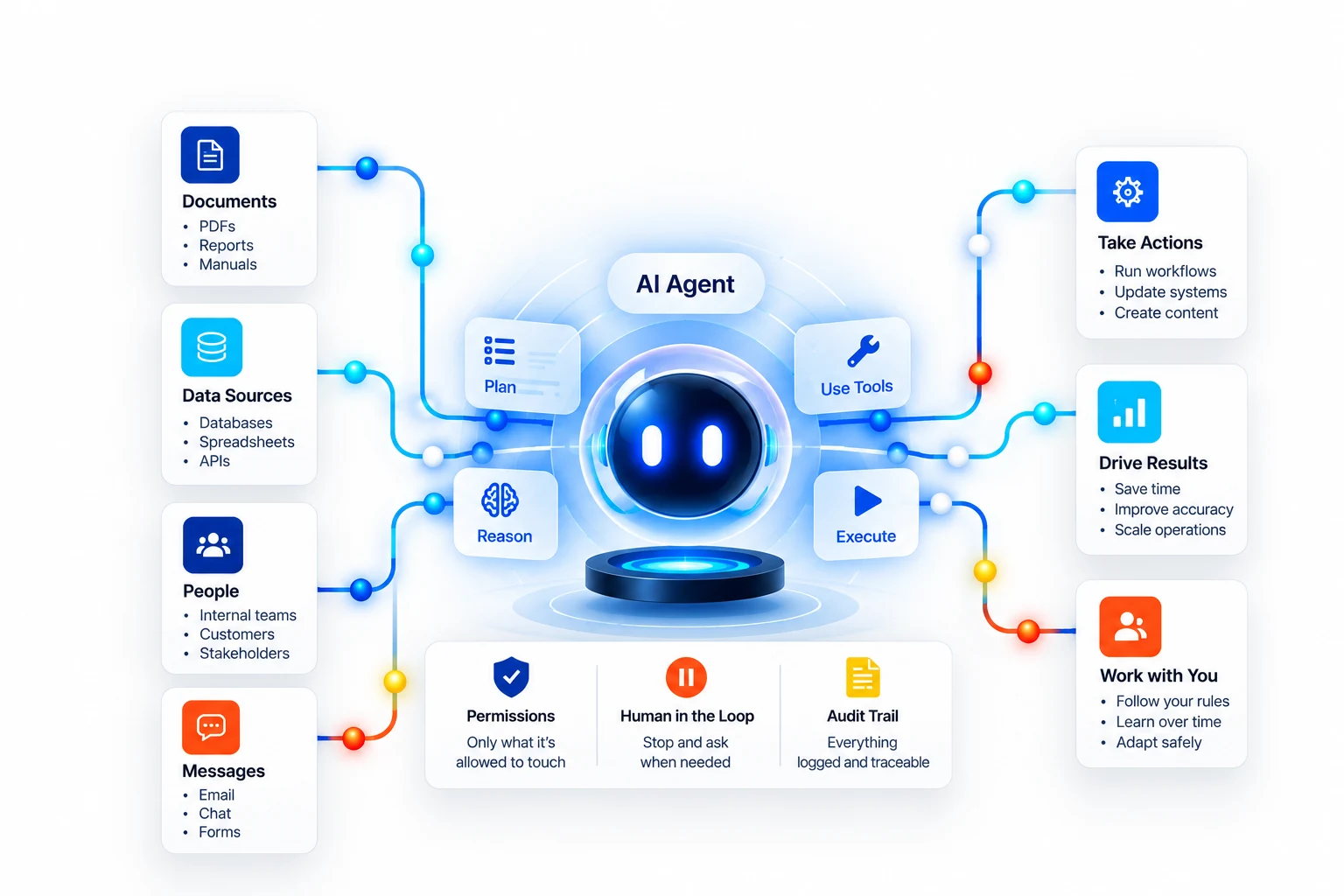
The real problem
Foundation models improved enormously without anybody here doing anything, and they will keep improving. What does not come out of the box is the boundary around one: what this agent may touch in your business, what it must ask about first, and what you can reconstruct when it does something you did not expect.
A bounded task, an explicit list of tools, approval points on the actions that matter, and traces you can read. The interesting engineering is in the constraints.
An agent given broad access and asked to be useful demos well and deploys badly. If nobody can say what it is not allowed to do, it is not finished.
Capability
Six areas. Not every engagement needs all of them, and the scope is agreed with you before anything starts.
Deciding what the agent is for before deciding what it runs on. Most agent projects fail as scoping exercises rather than engineering ones: the task was never bounded tightly enough for anyone to say whether the thing worked.
Several agents with narrow jobs, coordinated, rather than one asked to do everything. Narrow agents are easier to test, easier to correct and much easier to explain to the person who has to sign off on them.
The decision about which actions need a person is a design decision, not a setting. We make it explicitly, with you, and write it down: what proceeds, what pauses, and who is asked.
Agents are only as useful as what they can reach, and only as safe as what they cannot. Every tool an agent is given is a permission granted, so the integration work and the permission work are the same conversation.
What it did, why it decided to, what it was given and what it returned. Without this an agent is unfalsifiable: you cannot improve behaviour you cannot reconstruct, and you cannot defend it to an auditor either.
Agents are non-deterministic, so "it worked when I tried it" is not evidence. We build the test set alongside the agent and run it on every change, the same discipline any other software gets.
How we work
One job with a clear edge and a definition of done. We will tell you when the honest answer is a script or a form rather than an agent, which is more often than the market suggests.
Every system the agent can read, every action it can take, and the line between them. This is where the design is actually decided.
In your stack, in your repository. The evaluation set grows with the agent, so behaviour changes show up as failures rather than as surprises in production.
Three stages in, you have a working agent. The last two are what make it something you can run without us.
Deployed with logging, tracing and a cost ceiling from the first day, not added after the first incident. An agent you cannot observe is one you will end up turning off.
Your engineers change the prompts, the tools and the boundaries without calling us. The engagement is designed to end with them owning it.
Straight answer
If the rules fit on a page and the path never varies, you want ordinary software: cheaper to build, cheaper to run, and it behaves the same way every time. Agents earn their keep where the input is messy and the route changes, which is a narrower set of problems than the current enthusiasm suggests. We would rather scope you out of one than sell you a system you end up switching off.
Before you ask
Often not, and we would rather say so during scoping than six weeks in. If the task is deterministic and the rules fit on a page, ordinary software is cheaper to build, cheaper to run and far easier to reason about. Agents earn their place where the input is messy, the path varies and a person would otherwise read, judge and then act.
The permission map and the approval points, both agreed before anything is built. An agent only reaches the tools it has been given, and the actions you classify as high-consequence stop and wait for a person. That boundary is part of the design, not a setting someone can flip later without noticing.
LangChain, LangGraph, AutoGen and CrewAI for orchestration, with OpenAI, Azure AI and Anthropic Claude among the models. We are deliberately not tied to one: the model layer is moving quickly and anything built to be inseparable from this year’s best model is a liability by next year.
You do. Source in your repository under your licence, the evaluation set with it, and documentation written for the engineers who will maintain it. Nothing is held inside our tooling.
The evaluation set keeps running, and the traces are legible enough for your team to answer "why did it do that" without us. We would rather build something your engineers can interrogate than something only we understand.
Next
Tell us the job you are trying to get done. We will come back with whether an agent is the right shape for it, and what the boundary would have to look like if it is.
Related white papers and articles for AI Agent Development will appear here as they're published.
View MoreGet in touch and we'll help you find the right approach.
Talk to Us