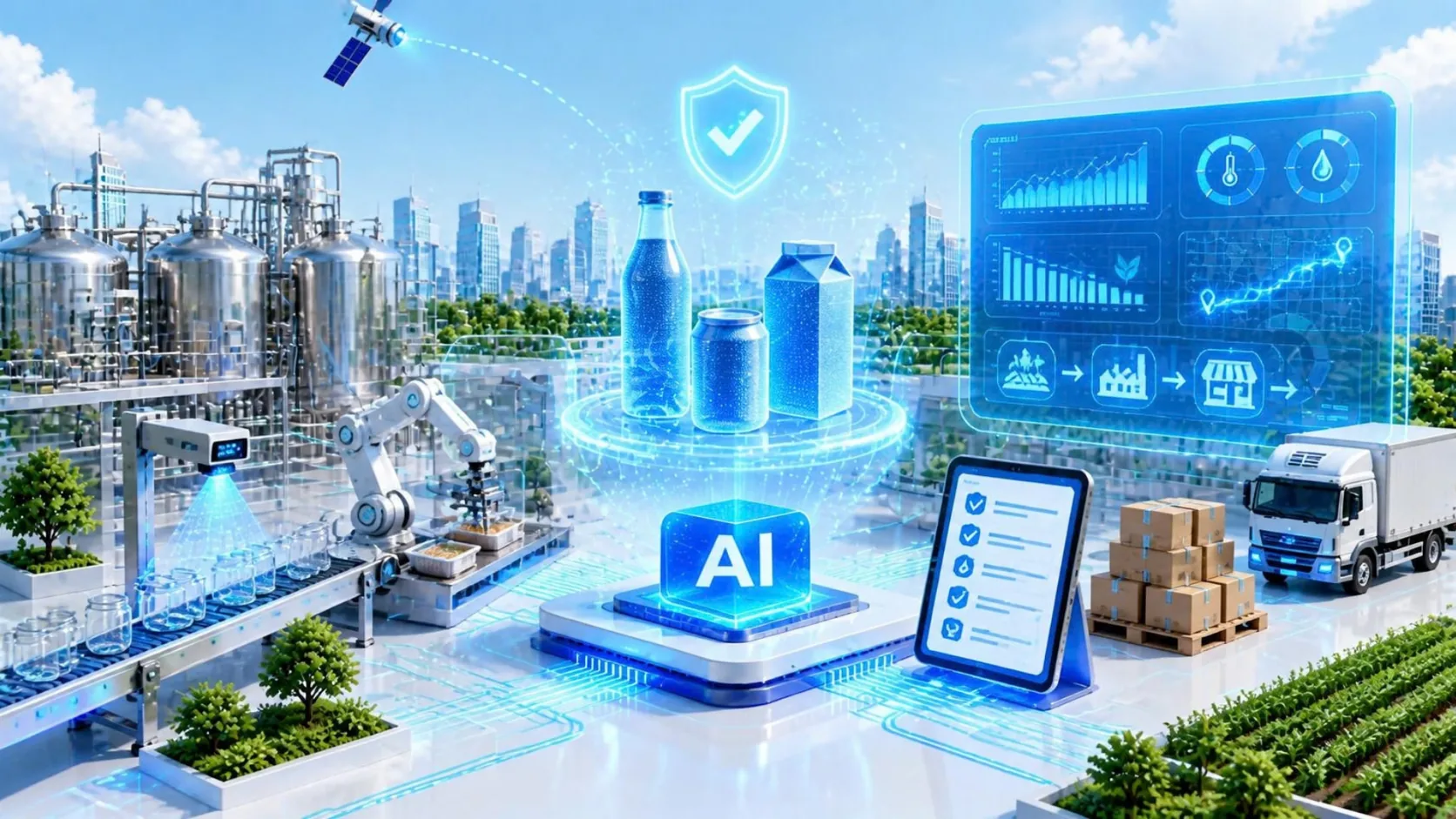
What Is AI Automation in Food & Beverage Manufacturing? Food manufacturing has a unique challenge:
The same product needs to come out right again and again—even when the conditions going into production are constantly changing.
Ingredients can vary. Temperature and humidity can change. Equipment performance can drift. Demand can rise unexpectedly. Packaging can contain errors. A small process deviation can affect quality, shelf life, waste, or production efficiency.
This is where AI automation becomes valuable.
AI automation in Food & Beverage Manufacturing combines production data, sensors, machine information, quality records, vision systems, traceability data, and automated workflows to help manufacturers understand what is happening, predict what may happen next, and respond before small deviations become larger problems.
The goal is not simply to automate more machinery.
It is to make the entire production process more visible, consistent, traceable, and adaptable.
In this guide
The Food Manufacturing Intelligence Loop Ingredient & Raw Material Intelligence Production Process Intelligence Product Quality Prediction Computer Vision for Quality Inspection Food Safety & Critical Process Monitoring Packaging, Label & Allergen Verification Batch & Ingredient Traceability Predictive Maintenance for Food Production Equipment Demand, Production Planning & Shelf Life Waste Reduction & Yield Improvement Water & Energy Intelligence Production Knowledge & AI Assistants From Monitoring to Adaptive Manufacturing AI Automation Does Not Mean Removing the Quality Team The Digital Batch Record Where Should a Food Manufacturer Start? The Goal: Consistency Through Intelligence The Food Manufacturing Intelligence Loop A useful way to understand AI in Food & Beverage is:
Understand what is entering production.
This may include:
Ingredients Raw materials Supplier information Formulations Production orders Packaging materials Temperature conditions Demand requirements Monitor what happens during production.
For example:
Mixing Heating Cooling Fermentation Filling Cutting Cooking Freezing Packaging Confirm that the output meets expectations.
AI can help evaluate:
Appearance Weight Fill level Packaging Labels Product specifications Process conditions Quality measurements Connect the finished product back to:
Ingredients Suppliers Batches Production lines Equipment Process conditions Inspection results Use what happened during one production run to improve the next.
That may mean:
Adjusting process parameters Improving maintenance Reducing waste Changing production planning Improving inspection Updating forecasts This creates an important idea:
Every Batch Creates Data for the Next Batch.
01 Ingredient & Raw Material Intelligence Food production begins before the production line starts.
Raw materials can differ from one delivery to another.
can affect how a product behaves during processing.
Traditional manufacturing may rely on fixed process settings designed around expected ingredient characteristics.
AI can help manufacturers respond to greater variability.
Imagine a production process where the characteristics of an incoming ingredient are measured.
The system could compare:
Ingredient condition + Historical production results + Recipe requirements
and identify whether production parameters may require attention.
The objective is not necessarily to allow AI to independently change a recipe.
It is to give production teams better information before variability affects the finished product.
This creates a stronger connection between:
raw-material condition and finished-product consistency.
02 Production Process Intelligence A food-production line generates large amounts of operational information.
Traditionally, operators monitor many of these values through predefined thresholds.
For example:
Temperature above limit → alert
AI can add another level.
It can analyze multiple signals together and identify patterns that may not yet have crossed a fixed alarm threshold.
Imagine:
Temperature slowly increasing + motor load changing + production speed declining → unusual process pattern identified
The system may flag the condition before a larger production problem develops.
This moves manufacturing from simply asking:
“Is the process outside its limit?”
toward:
“Is the process beginning to behave differently from normal?”
03 Product Quality Prediction Traditional quality control often confirms quality after a production step has already occurred.
But AI can also help manufacturers identify conditions that may lead to quality problems earlier.
Historical production data may reveal that a certain combination of conditions frequently leads to an undesirable result.
AI can help identify that pattern while production is still running.
The workflow could become:
Process conditions change AI detects increasing quality risk Operator receives warning Process investigated Corrective action taken Final quality verified The important distinction is:
Detecting a defective product versus Predicting the conditions that may create one.
Both have value.
Together, they can create a much stronger quality system.
04 Computer Vision for Quality Inspection Many food and beverage products still require visual inspection.
Computer vision allows cameras to become part of the quality-control process.
For example:
Product passes inspection point Camera captures image AI compares visual characteristics Potential defect identified Product flagged or routed for review This can support inspection at production speed and create consistent digital records of what the system observed.
Computer vision can be particularly useful when inspections are repetitive and the expected characteristics of the product are clearly defined.
But the objective should not simply be:
Replace human inspectors.
A stronger design can use AI to identify routine defects while quality specialists focus on unusual or uncertain cases.
05 Food Safety & Critical Process Monitoring Food manufacturing is different from ordinary manufacturing because some deviations can involve more than product quality.
They can affect food safety.
AI can support these systems by helping identify patterns, missing records, unusual conditions, or processes that deserve investigation.
For example:
Expected sanitation procedure Cleaning records collected Sensor and production information compared Missing or unusual condition identified Responsible team alerted The important principle is:
AI should strengthen food-safety controls—not bypass them.
Validated procedures, defined critical controls, qualified personnel, and required approvals still matter.
AI can make relevant information easier to identify and act on.
06 Packaging, Label & Allergen Verification A food product can be manufactured correctly and still create a serious problem if it is packaged or labeled incorrectly.
AI can help compare information across systems and physical packaging.
Consider a label-verification workflow.
Production order Approved formulation Required allergen information Packaging artwork Printed label AI-assisted comparison Mismatch flagged for review This connects information that may otherwise sit in separate systems.
It also creates another important principle for Food & Beverage AI:
The digital specification should match the physical product.
07 Batch & Ingredient Traceability Traceability answers a fundamental set of questions:
What went into this product? Where did it come from? When was it produced? Which equipment or production line was involved? Which finished products contain it? For a finished batch, relevant information might include:
Supplier Ingredient lot Production batch Process conditions Quality results Packaging lot Finished product This information becomes particularly important when a manufacturer needs to investigate a quality issue.
Instead of searching across disconnected documents and systems, an integrated traceability environment can help teams reconstruct the product journey much faster.
The goal is not simply to store more records.
It is to make those records usable when they matter.
08 Predictive Maintenance for Food Production Equipment Food and beverage production often depends on equipment that must operate reliably for long periods.
Equipment failure can create more than maintenance cost.
to identify changes that may indicate deterioration.
Instead of:
Machine fails → maintenance responds
the workflow can become:
Equipment behavior changes AI identifies abnormal pattern Maintenance team investigates Intervention planned Unexpected interruption potentially avoided This helps maintenance move from purely reactive work toward more condition-based decision-making.
09 Demand, Production Planning & Shelf Life Food manufacturers have another challenge:
Many products cannot simply remain in inventory indefinitely.
Producing too little can mean lost sales.
to support production planning.
The decision is not simply:
How much will customers buy?
It is:
How much should we produce, when should we produce it, and how much useful shelf life will remain when the product reaches the customer?
That makes Food & Beverage forecasting different from many non-perishable industries.
The relationship is:
Demand Production Plan Capacity Inventory Shelf Life Waste AI can help teams evaluate those variables together.
10 Waste Reduction & Yield Improvement Food manufacturing produces many forms of loss.
Some waste may appear small at one point in the process but become significant when repeated thousands of times.
AI can help production teams identify where loss occurs and which variables appear connected to it.
Consider filling operations.
If a package should contain a defined amount, manufacturers may deliberately overfill slightly to reduce the risk of underweight products.
But excessive overfill creates product giveaway.
AI can help analyze:
filler performance + product characteristics + line conditions + weight results
to identify opportunities for tighter control.
The goal is not merely:
Use less material.
It is:
Produce the correct product more consistently.
That improves both quality and yield.
11 Water & Energy Intelligence AI can help connect utility consumption to actual production activity.
Instead of only seeing:
Energy consumption increased this month.
teams can begin asking:
Which line? Which product? Which process stage? Under what conditions? For example:
Production output + equipment operation + energy consumption → energy intensity by production process
That can help manufacturers find abnormal consumption or inefficient operating conditions.
The same approach can be used for water.
This makes sustainability and operational efficiency part of the same data problem rather than completely separate initiatives.
12 Production Knowledge & AI Assistants Not every use of AI needs to control machinery.
Manufacturing teams also rely on large amounts of knowledge.
An AI assistant could help an operator ask:
“What should I check when this filler shows this alarm?”
The system could search approved operational knowledge and surface the relevant procedure.
Or a quality manager could ask:
“Show me the production history for this batch and any recorded quality deviations.”
The AI could retrieve information from connected systems and prepare a summary.
This can reduce time spent searching for information.
But production knowledge systems should use approved and controlled sources, especially where instructions involve food safety, equipment, or quality procedures.
From Monitoring to Adaptive Manufacturing Food factories already collect significant operational data.
The real opportunity is what happens after the data is collected.
A traditional monitoring system might tell the operator:
Temperature = 82°C
An intelligent system can begin asking:
Is 82°C expected at this point in this process? How does it compare with similar batches? Is another variable changing at the same time? Does this pattern usually lead to a quality problem? Does anyone need to act? This represents a progression:
Record What happened? Detect Is something unusual? Predict What may happen next? Recommend What should we investigate or change? Act Can an approved response be performed? The more authority the system receives, the more carefully its boundaries need to be defined.
AI Automation Does Not Mean Removing the Quality Team Food manufacturing contains expertise that cannot simply be replaced by an algorithm.
Production teams understand the line. Quality teams understand specifications. Food-safety specialists understand hazards and controls. Maintenance teams understand equipment. Product developers understand formulation. AI can connect and analyze information across these areas.
A useful operating model is:
AI Monitors What is happening? AI Detects What appears unusual? AI Predicts What may happen next? AI Recommends What deserves attention? Automation Executes Which predefined low-risk actions are permitted? Which decisions require production, quality, maintenance, or food-safety judgment? The goal is not:
People versus AI.
It is:
Better production decisions with both.
The Digital Batch Record One of the most useful ways to think about intelligent food manufacturing is to treat every production batch as a connected digital story.
Imagine a finished product batch containing:
01 Ingredient History Which materials and supplier lots were used?
02 Process History What temperatures, times, pressures, speeds, and conditions occurred?
03 Equipment History Which machines were used and what was their condition?
04 Quality History What inspections and test results were recorded?
05 Packaging History Which packaging and label were used?
06 Traceability History Where did the finished products go?
Now imagine AI being able to analyze these histories across thousands of batches.
That creates the opportunity to discover relationships such as:
These ingredient characteristics combined with these process conditions are associated with higher waste.
or:
This equipment behavior often appears before quality begins to drift.
or:
These production conditions tend to create the most consistent output.
That is where food manufacturing becomes more than automated.
It becomes data-driven and continuously improving.
Where Should a Food Manufacturer Start? Do not begin with:
“How can we add AI to the entire factory?”
Start with one production problem.
Then ask five questions.
01 What Does Good Look Like? Is the expected product or process condition clearly defined? 02 Can We Measure What Is Happening? Do we have the required sensors, images, records, or system data? 03 Can AI Identify Something Useful? A defect? A pattern? A prediction? A deviation? 04 Can Someone Act on It? Production? Quality? Maintenance? Automation? 05 Can We Verify the Result? Did quality, yield, downtime, waste, or efficiency actually improve? If those questions can be answered, the use case has a much stronger foundation.
The Goal: Consistency Through Intelligence Food manufacturing will always contain variability.
Ingredients vary. Equipment wears. Demand changes. Environmental conditions change. People encounter exceptions. The objective of AI is not to pretend that variability does not exist.
It is to understand it earlier and respond more intelligently.
That creates the complete Food & Beverage intelligence loop:
01 Input Know what enters the process. 02 Transform Understand what happens during production. 03 Verify Confirm that the product meets expectations. 04 Trace Maintain the relationship between ingredients, process, batch, and finished product. 05 Improve Use every production result to make future operations better. That is the opportunity behind AI automation in Food & Beverage Manufacturing.
Not simply:
More automation.
But:
More consistent production, better information, and faster learning from every batch.
Next article →
Step 02 · Evaluate
7 Key Success Factors for AI Automation in Food & Beverage
Learn what manufacturers should evaluate before implementation—including product specifications, process visibility, food-safety controls, traceability, equipment integration, production economics, and workforce ownership.
Read the Article →