White Papers & Articles
Related white papers and articles for Enterprise AI Solutions will appear here as they're published.
View MoreEnterprise AI Solutions
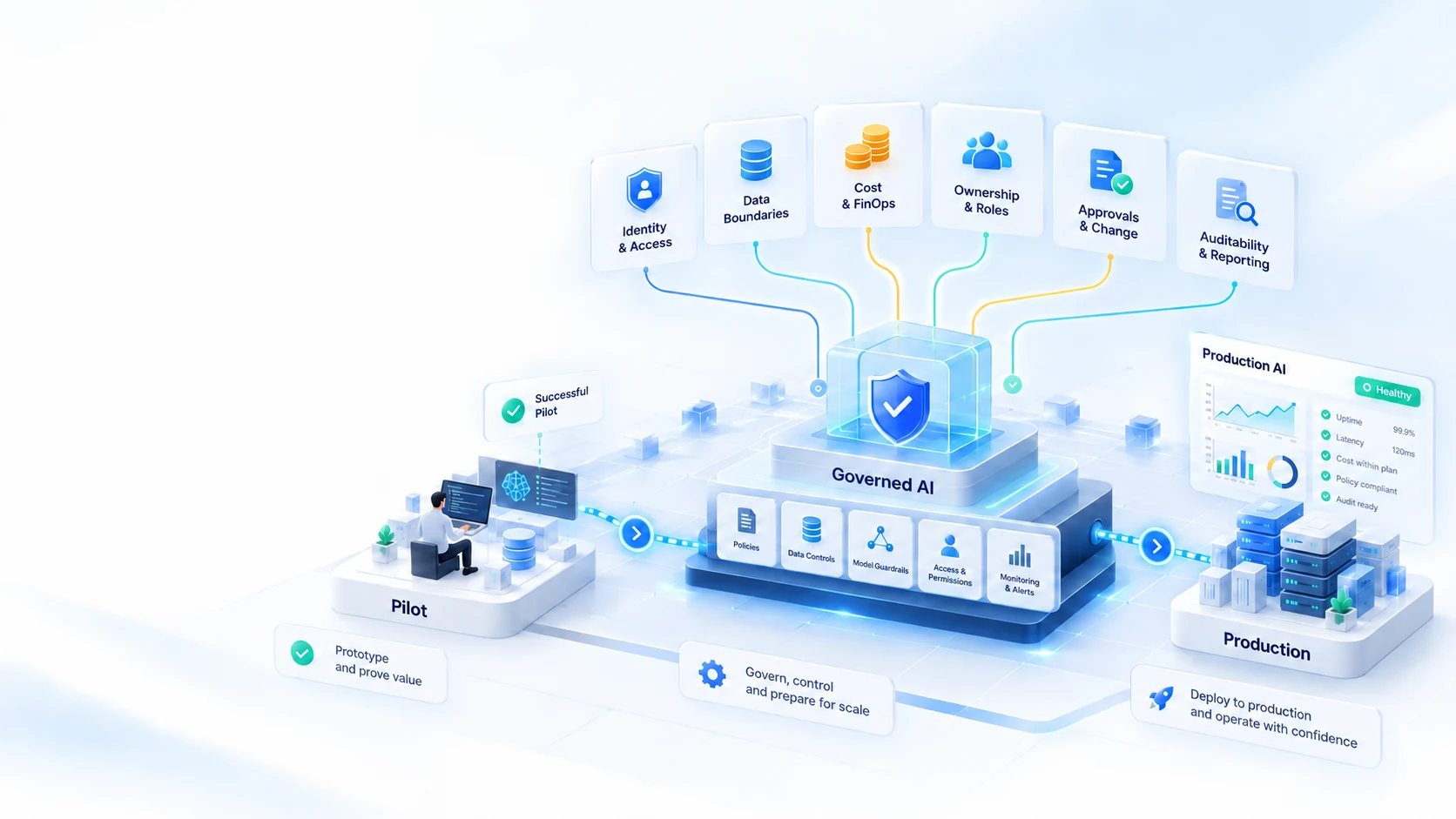
What stops the next step is identity, data boundaries, cost, ownership and somebody able to answer an auditor. We do the half of the job that decides whether AI reaches production and stays there.
The gap
A pilot proves the model can do the task. Production asks a different set of questions, and they are not model questions: whose identity is it acting under, which data may it see, what does it cost per use, who owns it on a Tuesday afternoon, and what do you show an auditor. Those are answerable, but not by improving the prompt.
One team, one dataset, a short horizon and a demo at the end. Genuinely useful, and almost always answered yes.
Identity, data boundaries, cost, change management, ownership and evidence. This is the work on this page.
Capability
Six areas. Scope is agreed with you first, and a first engagement rarely needs all of it.
Which problems are worth AI at all, in what order, and what each one is worth if it works. Written down before anything is built, so the business case survives a change of sponsor.
Where the model runs, what data reaches it, and what leaves. Azure OpenAI, AWS Bedrock, Google Vertex AI or a private deployment - chosen by where your data is allowed to be, not by preference.
Who may use which capability, how decisions are recorded, and what you hand an auditor. ISO 27001, GDPR and SOC 2 shape this work rather than being checked off at the end of it.
Versioned models, reproducible deployments, evaluation on every change and a way back to the previous version. The difference between a system you can change and one nobody dares touch.
Token and inference spend is a running cost that behaves like nothing else in the budget. Ceilings, attribution per workload and alerting belong in the design, not in the first surprising invoice.
Models change underneath you, data drifts and usage grows in directions nobody planned. Somebody has to own that, and the handover decides whether it is your team or a permanent dependency on us.
How we work
The pilots, the data, the platform commitments and the constraints you cannot move. Most of the decisions are already made by the time we arrive; the job is finding which ones.
Identity, boundaries, logging and deployment decided once, so the second and tenth use case cost a fraction of the first. Building per-feature is how an AI programme stalls at three pilots.
In your cloud, your repository, your identity provider. Wired into the systems people already use rather than added as another place to go.
Three stages in, it runs. The last two are what make it yours rather than ours.
Evaluation sets, cost measured per workload, and access reviewed. The point is to be able to say what it does and does not do, with something behind the answer.
Documentation, runbooks and training for the people who will operate it. You own the platform outright, including the parts that are inconvenient for us.
Straight answer
It is not, and a page claiming otherwise should worry you. Security and compliance are properties of a specific design - where the model runs, whose identity it acts under, what is logged, what a reviewer can reconstruct - and they hold only for the system actually built. What we can offer is that those questions are answered before the build rather than during the audit, and that the answers are written down where your team can check them.
Before you ask
Usually because each was built as a feature rather than on a platform, so every one had to solve identity, data access, logging and cost from scratch, and each faced the same review with no precedent. The fix is unglamorous: decide those once, then use cases get cheaper rather than more expensive.
No. Which deployment is appropriate depends on what the data is and where it is allowed to be, and that question comes before the model choice. Private and in-region deployments are available, and sometimes the right answer is that a particular dataset never leaves your estate.
Ceilings and attribution built in from the start, so spend is visible per workload rather than as one line at the end of the month. We cannot promise a figure without knowing your usage, and anyone who does is guessing.
They overlap and they are not the same. That page is the security architecture itself - zero-trust design, permissions, approval flows, audit logging, responsible AI policy. This one is the whole programme, of which that is a part. If security architecture is the specific thing you need, start there.
The architecture, the pipelines, the infrastructure code and the documentation, in your repositories under your licence. The measure of a good engagement is that your team can run it without us, and we would rather be asked back than depended on.
Next
Tell us what you built, where it stopped and who said no. We will come back with what would have to be true for it to ship, and whether that is worth doing.
Related white papers and articles for Enterprise AI Solutions will appear here as they're published.
View MoreGet in touch and we'll help you find the right approach.
Talk to Us