Civic Tech

Smart Municipality &
Digital Government Solutions

Connected & Efficient Communities

Helping municipalities, local governments, and public organizations improve citizen services, modernize public infrastructure, enhance operational efficiency, and build smarter, more connected communities through AI, automation, cloud technologies, and digital transformation.

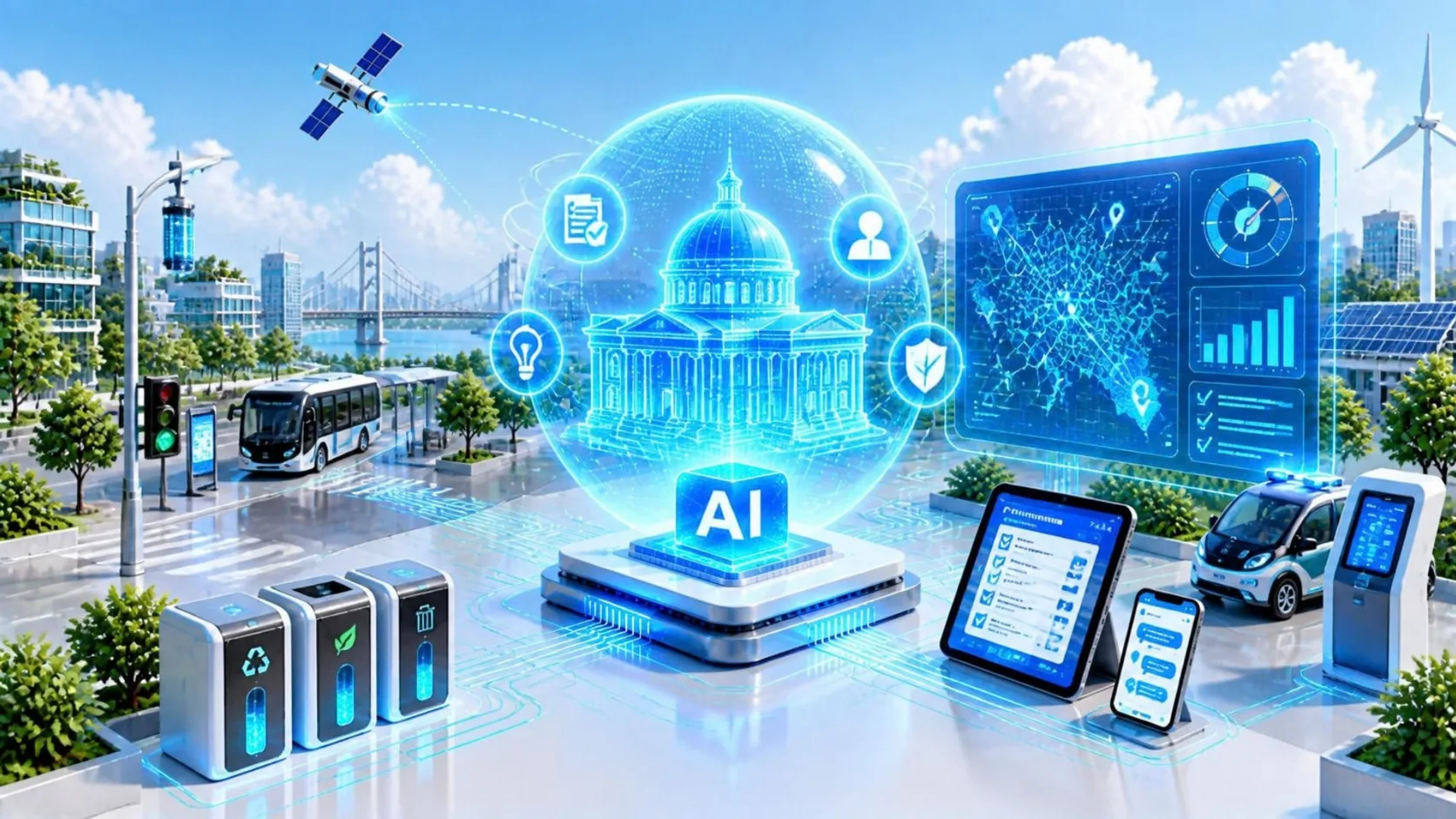
Illustration of a connected smart municipality: a glowing holographic city hall inside a protective dome above an AI platform, with document, citizen, idea and security icons around it, linked by light trails to a street with a smart traffic light, a streetlight sensor and an electric bus, a bridge, smart recycling bins, a city dashboard with a map, gauge and service charts, an online form on a tablet, a citizen chat on a phone, a self-service kiosk, an emergency vehicle, solar panels and a wind turbine.
Industry Challenges

Key Challenges for Modern Municipalities

  1. Citizen Access & Inclusive Public Services

    Residents expect fast, digital, and convenient access to government services from any device.

    • Digital access
    • Multilingual communication
    • Easy Japanese
    • Accessibility
    • Service requests
    • One-stop services
  2. Administrative Efficiency, Data & Workforce

    Paper-based workflows and fragmented systems slow approvals, increase workloads, and reduce operational efficiency. Departments often operate independently, making it difficult to share information and make coordinated decisions.

    • Workflow automation
    • Knowledge management
    • Interdepartmental data
    • Staff workload
    • Evidence-based decisions
  3. Infrastructure, Mobility & Sustainable Operations

    Legacy systems and aging infrastructure increase maintenance costs and limit the ability to deliver modern public services. Increasing populations place greater pressure on transportation networks, utilities, and public infrastructure.

    • Roads
    • Facilities
    • Traffic
    • Waste
    • Energy
    • Environment
    • Predictive maintenance
  4. Resilience, Emergency Response & Public Trust

    Cities require better tools to monitor risks, coordinate emergency services, and respond quickly to unexpected events.

    • Disaster information
    • Situational awareness
    • Communications
    • Human oversight
    • Transparency
    • Privacy
    • Accountability
Opens in a new tab
Solutions

Technology Solutions for Municipalities

Comprehensive capabilities to modernize public services and city operations.

Need → Evidence → Decision → Service → Accountability

Smarter government should mean easier services for residents, better tools for public employees, and decisions that remain accountable to people.

  1. Need

    A resident request, infrastructure problem, administrative case, sensor alert, emergency signal, or community need.

  2. Evidence

    Regulations, municipal records, applications, GIS, sensor data, operational history, and verified external information.

  3. Decision

    Apply rules, policy, professional judgment, and appropriate AI support.

  4. Service

    Issue information, process an application, coordinate departments, dispatch work, maintain infrastructure, or respond to an emergency.

  5. Accountability

    Record what happened, preserve human authority, explain important decisions, measure outcomes, and improve the service.

Digital Citizen Services

Provide online portals, AI-powered virtual assistants, and automated workflows for permits, service requests, and public information.

Powered by AI Agent Development

Process Automation

Automate administrative workflows including permits, inspections, document processing, reporting, and interdepartmental collaboration.

Powered by Business Process Automation

Cloud & Government System Integration

Connect existing government systems, cloud platforms, GIS solutions, and public databases to improve operational efficiency.

Powered by System Integration

Data & Municipal Analytics

Transform operational data into dashboards and actionable insights that support evidence-based planning and decision-making.

Powered by AI Data & Analytics

Smart Traffic Management

Leverage AI and real-time traffic data to optimize signal timing, reduce congestion, and improve transportation efficiency.

Powered by AI Data & Analytics

Predictive Infrastructure Maintenance

Monitor roads, utilities, public facilities, and critical infrastructure to identify maintenance needs before failures occur.

Powered by AI Data & Analytics

Intelligent Waste Management

Optimize waste collection using IoT sensors, route optimization, and real-time monitoring to improve efficiency and reduce costs.

Powered by AI Data & Analytics

Environmental Monitoring

Monitor air quality, weather conditions, noise levels, and environmental data to support informed planning and sustainability initiatives.

Powered by AI Data & Analytics

Emergency Response Optimization

Improve emergency coordination with intelligent dispatch systems, predictive analytics, and real-time situational awareness.

Powered by AI Data & Analytics

Custom Civic Technology Development

Develop secure digital platforms, citizen portals, mobile applications, and smart city solutions tailored to municipal needs.

Powered by Custom Software Development

Articles

Most Viewed Articles

AI Journey Guides

Explore AI for Municipalities Step by Step

Practical guidance for municipal leaders — from understanding AI automation to evaluating public-sector readiness and implementing AI responsibly across resident services and city operations.

  1. Step 01 Understand

    What Is AI Automation in Municipal Government?

    Understand how AI can help municipalities improve citizen services, streamline administrative work, connect departmental knowledge, monitor infrastructure, support emergency response, and strengthen evidence-based public operations.

  2. Step 02 Evaluate

    7 Key Success Factors for AI Automation in Municipalities

    Learn what municipalities should evaluate before implementation—including public purpose, authoritative data, legal and policy boundaries, inclusion, system integration, human oversight, and measurable public value.

  3. Step 03 Implement

    A Practical Guide to AI Implementation in Municipal Government

    Follow a controlled path from selecting a public-service outcome and mapping rules, data, departments, and decision authority to testing, piloting, deployment, monitoring, accountability, and scale.

AI Journey Guides · Step 01 · Understand

What Is AI Automation in Municipal Government?

A municipality handles thousands of decisions and interactions that affect everyday life.

  • A resident moves into the city and needs to understand several procedures.
  • A parent needs information about childcare.
  • A foreign resident needs an important notice in language they can understand.
  • A department receives hundreds of applications that must be checked and routed.
  • A road begins showing signs of deterioration.
  • Waste collection demand changes by neighborhood.
  • Heavy rain creates rapidly changing information about rivers, roads, shelters, and evacuation.

Municipal employees must turn all of these signals into public services.

AI can help.

AI automation in Municipal Government combines artificial intelligence, authoritative government information, operational data, rules, and automated workflows to help municipalities improve resident services, administrative work, infrastructure operations, emergency response, and evidence-based decision support.

But government automation has a different responsibility from ordinary business automation.

A municipality cannot optimize only for speed or cost.

It also needs to consider accessibility, legal authority, fairness, privacy, transparency, human oversight, and public accountability.

The objective is therefore not:

Automate Government

It is:

Make Public Services Easier, Faster and More Effective While Preserving Public Responsibility.

The Municipal Intelligence Cycle

A useful way to understand Municipality AI is:

  1. Need

    Something requires attention.

    It may be:

    • a resident question
    • an application
    • an infrastructure issue
    • an administrative case
    • a sensor alert
    • an emergency
  2. Evidence

    The municipality gathers the information required to understand the situation.

    That may include:

    • municipal records
    • regulations
    • forms
    • GIS data
    • sensors
    • operational history
    • applications
    • verified external information
  3. Decision

    Rules, policy, professional judgment, and AI-supported analysis help determine what should happen.

  4. Service

    The municipality responds.

    It may:

    • provide information
    • process a request
    • issue a document
    • coordinate departments
    • dispatch work
    • maintain infrastructure
    • communicate during an emergency
  5. Accountability

    The municipality needs to understand and, where appropriate, explain what happened, who had authority, what information supported the action, and whether the service achieved the intended outcome.

That is the municipal intelligence loop.

Digital Citizen Services

One of the clearest opportunities for municipal AI is helping residents navigate public services.

Government services are often organized around departments.

Residents are not.

A resident may simply say:

“I am moving into the city. What do I need to do?”

But that life event may involve several different procedures.

  • Address registration
  • Health insurance
  • Child-related services
  • Taxes
  • Waste rules
  • Schools
  • Other municipal processes

The resident should not need to understand the municipality's internal organizational structure before receiving help.

AI can help translate:

Resident NeedintoRelevant Municipal Procedures

A digital municipal assistant could help explain which procedures may apply, what documents are required, where the service is available, and what the next step is.

This creates a better service model:

  1. Life Event
  2. Relevant Procedures
  3. Required Information
  4. Guided Next Steps

Japan's Digital Agency is already pursuing municipal-counter transformation around the idea of services that reduce writing, waiting, and moving between counters, with the stated aim of creating people-friendly digitalization that leaves no one behind. digital.go.jp

AI can become another layer in that transformation.

Multilingual and Easier-to-Understand Government Information

Municipal information can be difficult to understand even for native speakers.

Administrative language often contains:

  • technical terms
  • legal terminology
  • long explanations
  • department-specific language
  • unfamiliar procedures

The challenge becomes greater for residents who do not speak the primary language fluently.

AI can help municipalities transform approved information into forms that are easier to understand.

For example:

  1. Official Municipal Information
  2. Plain-Language Explanation
  3. Easy Japanese
  4. Multilingual Version
  5. Staff Review Where Required
  6. Resident Communication

This can be particularly useful for information about:

  • disaster preparedness
  • childcare
  • welfare
  • tax
  • waste collection
  • public facilities
  • administrative procedures

The important principle is that AI should work from authoritative municipal information.

It should not invent procedures simply because a generated answer sounds reasonable.

Applications, Forms and Administrative Procedures

Municipal government still contains large amounts of repetitive administrative work.

A single application may require staff to:

  • receive documents
  • check required fields
  • identify missing information
  • classify the request
  • find related records
  • route it to the correct department
  • request additional information
  • update internal systems

AI and process automation can assist with parts of this workflow.

For example:

  1. Application Received
  2. Documents Classified
  3. Required Fields Checked
  4. Relevant Information Retrieved
  5. Missing Information Identified
  6. Case Routed
  7. Staff Review

The goal is not automatically to let AI make every public decision.

Often, the first value comes from reducing the administrative work around the decision.

AI can prepare the case.

A qualified public employee can remain responsible for the consequential judgment.

Internal Government Knowledge

Municipalities contain enormous amounts of institutional knowledge.

  • Procedures
  • Manuals
  • Regulations
  • Past cases
  • Internal notices
  • Departmental guidance
  • Frequently asked questions
  • Operational handover documents

Much of this information may exist across different folders, systems, documents, and departments.

This creates a common problem:

The Municipality Knows the AnswerbutThe Employee Cannot Find It Quickly

AI-powered knowledge systems can help staff search internal information using natural language.

For example, an employee could ask:

“What procedures apply when a resident moves out while receiving this service?”

Instead of manually searching multiple documents, AI could identify relevant approved materials and help organize the answer.

A strong system should also show where the information came from.

That distinction is important in government.

The objective should not be:

“Trust the AI answer.”

It should be:

“Understand the answer and its source.”

Connecting Departments and Data

Municipal services often cross organizational boundaries.

  • Housing data may exist in one system.
  • Welfare information in another.
  • Facility information somewhere else.
  • Infrastructure, GIS, waste, traffic, finance, and citizen-service systems may all be separate.

This creates data silos.

AI can help connect information across systems, but the goal should not necessarily be to place every municipal record into one giant database.

Instead, systems can be connected around the public service being delivered.

For example:

  1. Resident Request
  2. Identity / Case Context
  3. Relevant Department Information
  4. Applicable Rules
  5. Staff View

This reduces the amount of manual searching and repeated data entry required across departments.

The same principle applies to operational services.

Road maintenance, public facilities, traffic, environmental monitoring, and emergency management can become more effective when relevant information is connected.

Municipal Data & Decision Support

Municipal governments collect information about how communities function.

Depending on the municipality, this may include:

  • service demand
  • population trends
  • facility use
  • traffic
  • waste
  • infrastructure
  • energy
  • public inquiries
  • geographic information

AI can help identify patterns in this data.

For example, a municipality might ask:

“Which public facilities are experiencing the strongest increase in usage?”

Or:

“Where are resident inquiries about the same issue increasing?”

Or:

“Which areas show repeated infrastructure maintenance problems?”

AI can help organize large volumes of information and identify signals that deserve attention.

But data analysis and public policy are not the same thing.

AI can show:
what appears to be happening.
Public officials still need to decide:
what government should do about it.

Infrastructure & Predictive Maintenance

Municipalities manage physical assets that residents depend on.

  • Roads
  • Public buildings
  • Water-related infrastructure
  • Lighting
  • Public facilities
  • Equipment
  • Other community assets

Traditional maintenance can become reactive:

Failure Occurs → Complaint Received → Inspection → Repair

AI can help shift some maintenance toward earlier intervention.

For example:

Inspection History+Sensor Data+Asset Age+Maintenance History→Risk Pattern Detected

  1. Inspection Prioritized
  2. Staff Assessment
  3. Maintenance Decision

The AI does not need to independently decide that a bridge, road, or public building is safe.

Its role may simply be to help engineers and public-works teams identify where inspection resources should be focused.

That can make limited municipal resources more proactive.

Smart Traffic & Mobility

Municipal traffic conditions change throughout the day.

Congestion may vary according to:

  • time
  • weather
  • events
  • construction
  • school schedules
  • public transport
  • incidents

AI can help analyze information from sources such as traffic sensors, cameras where legally and appropriately used, road conditions, historical patterns, and public transportation data.

A traffic-management system might identify:

Expected TrafficversusActual Traffic

  1. Abnormal Congestion Detected
  2. Relevant Teams Alerted
  3. Traffic Response Evaluated

Over time, municipalities can better understand recurring patterns and improve transportation planning.

The goal should not simply be to move vehicles faster.

Municipal mobility can involve broader public objectives such as safety, accessibility, public transport, pedestrians, emergency access, and community needs.

Intelligent Waste Management

Waste collection is another highly practical municipal AI use case.

Traditional collection routes may operate on fixed schedules even when waste volume changes.

But collection demand may vary by:

  • neighborhood
  • day
  • season
  • events
  • commercial activity
  • other conditions

AI can combine information such as:

  • historical collection data
  • sensor information where available
  • traffic
  • vehicle position
  • route history
  • expected waste volume

The process could become:

  1. Waste Demand Forecast
  2. Route Requirements
  3. Traffic Conditions
  4. Collection Plan
  5. Actual Collection
  6. Operational Learning

The result may be better route planning, fewer unnecessary trips, lower operational burden, and more reliable collection.

The important point is that AI connects prediction to a real municipal workflow.

Environmental & Facility Intelligence

Municipalities also operate facilities and monitor environmental conditions.

AI can help analyze:

  • building energy consumption
  • public-facility usage
  • water or environmental signals
  • equipment performance
  • patterns in resource consumption

Imagine several public facilities.

The municipality may know each building's monthly energy use.

AI can help identify:

which facility is behaving differently from similar facilitiesorwhich operating pattern appears associated with unusually high consumption.

This turns reporting into operational intelligence.

Instead of simply asking:

“How much energy did we use?”

staff can ask:

“Where is consumption unusual, and what should we investigate?”

The system supports investigation.

People determine the appropriate response.

Emergency & Disaster Information

Emergency response is one of the clearest examples of why Municipality AI requires careful human oversight.

During a disaster, information may arrive from many sources at once.

  • Weather alerts
  • River data
  • Road conditions
  • Shelter status
  • Resident reports
  • Field staff
  • Maps
  • Emergency services
  • Public communications

The problem is often not a lack of information.

It is too much information arriving too quickly.

AI can help:

  • collect
  • classify
  • deduplicate
  • summarize
  • map
  • prioritize information

The workflow might be:

  1. Signals Collected
  2. Information Organized
  3. Potential Urgency Identified
  4. Situation Presented to Authorized Staff
  5. Human Review
  6. Public Communication / Operational Response

This is an important distinction.

AI can accelerate situational awareness.

But consequential emergency decisions should have clearly defined authority.

Government needs to know who decides and who communicates.

Citizen Requests and Issue Routing

Residents report many everyday problems.

  • A damaged road
  • Illegal dumping
  • A broken streetlight
  • A fallen tree
  • Noise
  • A public-facility problem

These reports may arrive through:

  • phone
  • email
  • web forms
  • mobile applications
  • municipal counters

AI can help classify requests and route them to the correct department.

For example:

  1. 01Resident Report“Streetlight not working near the park.”
  2. 02AI ClassifiesPublic infrastructure / lighting.
  3. 03Location Identified
  4. 04Existing Similar Reports Checked
  5. 05Responsible Team Identified
  6. 06Work Request Prepared
  7. 07Staff or Field Team Responds

This reduces manual triage.

It can also make it easier to identify when multiple reports refer to the same problem.

AI Assistants for Municipal Employees

Municipal employees may spend significant time:

  • searching documents
  • summarizing information
  • preparing drafts
  • checking administrative materials
  • responding to repetitive questions
  • organizing case information

Generative AI can assist with some of this work.

For example, a municipal employee might use an approved assistant to:

  • summarize a long internal document
  • draft a plain-language explanation
  • compare two policy documents
  • prepare meeting notes
  • organize resident inquiries
  • search approved internal knowledge

Government adoption of AI is already expanding internationally. OECD's 2026 Digital Government Outlook reports AI use in at least one area of government in 35 of 36 surveyed OECD countries, with internal operations and public services among the strongest areas of adoption.

But government use requires more than access to a model.

It needs governance around information, permissions, appropriate use, oversight, and accountability.

Citizen-Facing AI and Government-Operations AI Are Different

Municipality AI operates in two connected worlds.

Citizen-Facing Government

AI may help residents:

  • understand information
  • find services
  • navigate procedures
  • communicate across languages
  • submit requests
  • receive updates

Government Operations

AI may help public employees:

  • process cases
  • search knowledge
  • analyze data
  • coordinate departments
  • monitor infrastructure
  • optimize operations
  • respond to emergencies

The technology may be similar.

But the users, risks, workflows, and decision authority can be very different.

A successful municipal AI strategy needs to understand both.

Digital First — Not Digital Only

AI and digital services can make government easier for many residents.

But not everyone will use them in the same way.

Some residents may:

  • have limited digital skills
  • need accessibility support
  • prefer face-to-face assistance
  • have difficulty with the primary language
  • be dealing with a complicated situation that cannot easily be handled through automation

The objective should therefore not be:

Force Every Resident Into the Same Digital Channel

It should be:

Use Digital Technology to Make Every Channel Better

  • A municipal counter employee can benefit from the same AI knowledge tools used by an online assistant.
  • A call-center employee can access the same approved information.
  • A resident can begin online and continue with a person when necessary.

Japan's Digital Agency describes its municipal-counter DX program as combining resident convenience with reduced staff workload while aiming for people-friendly digitalization in which no one is left behind. digital.go.jp

That is a useful principle for municipal AI as well.

AI Support Is Not the Same as Public Authority

This is one of the most important concepts in Municipal AI.

AI may be able to:

  1. SearchFind relevant information.
  2. SummarizeOrganize complex material.
  3. ClassifyIdentify the type of request.
  4. PredictEstimate what may happen.
  5. RecommendSuggest an action.
  6. PreparePrepare a workflow or draft decision.

But that does not automatically mean the AI should have authority to make every decision.

A useful separation is:

IntelligenceWhat does the system know or infer?

versus

AuthorityWho is legally and operationally allowed to decide?

For low-risk administrative tasks, more automation may be appropriate.

For decisions that significantly affect residents, benefits, rights, safety, or other consequential outcomes, clearer human authority, review, traceability, and avenues for correction become increasingly important.

OECD's 2026 assessment of AI in government similarly emphasizes stronger requirements for data quality, transparency, assurance and governance as AI moves into higher-stakes public functions.

From AI Assistant to Agentic Government Services

Municipal AI may also gradually move beyond answering questions.

The maturity path could look like:

  1. AnswerExplain a municipal procedure.
  2. GuideIdentify which procedures a resident may need.
  3. PreparePre-fill or organize required information.
  4. RouteSend the case to the correct workflow or department.
  5. CoordinateConnect several related government processes.
  6. ActExecute specifically authorized administrative steps.

This creates the possibility of more proactive and integrated public services.

But autonomy changes the risk.

When AI begins taking actions across government systems, municipalities need clearer permissions, decision trails, approval points, accountability, and mechanisms to stop or correct actions.

OECD's 2026 Digital Government Outlook specifically highlights this distinction between AI that answers and agentic systems that act across government workflows, noting the corresponding need for oversight, traceability, accountability, user control, and challenge mechanisms.

Automate the Work — Preserve Public Authority

A strong municipal principle is:

Automate the Work

but Preserve Public Authority

  • AI can reduce administrative burden.
  • It can retrieve information faster.
  • It can prepare documents.
  • It can classify requests.
  • It can analyze operational data.
  • It can identify patterns.
  • It can support forecasts.

But public authority should remain deliberately designed.

For every AI-supported process, municipalities should understand:

  • What is AI doing?
  • Which information is it using?
  • What action can it take?
  • Who is responsible?
  • When is human approval required?
  • What happens when the AI is wrong?
  • How can the resident receive help or correction?

These are part of the service design—not questions to add after deployment.

Public Trust Matters

Efficiency is valuable.

But people also care about how government uses AI.

OECD's 2026 international trust survey found more optimism about AI's potential to improve public services or reduce costs than confidence that government AI would consistently preserve principles such as fairness, privacy, transparency, and human oversight.

That means successful Municipal AI needs both:

PerformanceDoes the service work better?

and

TrustworthinessCan people understand and trust how AI is being used?

Public-sector AI needs both.

Where Should a Municipality Start?

Do not begin with:

“Where can we use AI everywhere?”

Begin with one public-service problem.

For example:

  • Residents struggle to understand this procedure.
  • Staff repeatedly answer the same questions.
  • Applications require too much manual classification.
  • Knowledge is difficult to find across departments.
  • Waste routes are inefficient.
  • Facility energy use is difficult to understand.
  • Infrastructure inspections are too reactive.
  • Emergency information takes too long to organize.

Then ask:

  1. 01Is There a Clear Public Need?What problem are residents or employees experiencing?
  2. 02Is There Reliable Evidence?Do we have authoritative information and usable data?
  3. 03Is the AI Role Appropriate?Should it search, summarize, classify, predict, recommend, prepare, or act?
  4. 04Who Has Authority?Which actions require staff review or approval?
  5. 05Can We Measure Public Value?Did the service become easier, faster, more accessible, safer, more reliable, or less burdensome?

That is a stronger foundation than starting with the technology.

Before, During & After a Municipal Service

Municipal AI can also be understood across three moments.

  1. Before the Service

    Understand & Prepare

    • Identify the resident need.
    • Retrieve relevant information.
    • Determine applicable procedures.
    • Prepare the case.
  2. During the Service

    Assist & Coordinate

    • Guide the resident.
    • Support municipal staff.
    • Connect departments.
    • Monitor operational conditions.
    • Handle exceptions.
  3. After the Service

    Record & Improve

    • Understand what happened.
    • Record important actions.
    • Measure service performance.
    • Identify recurring issues.
    • Improve the process.

This creates:

  1. Understand
  2. Coordinate
  3. Deliver
  4. Account
  5. Improve

The Goal: Government That Is Easier to Navigate

  • Residents should not need to understand every municipal department.
  • Employees should not need to search five systems for one answer.
  • Infrastructure teams should not always have to wait for failure before acting.
  • Emergency teams should not have to manually sort every incoming signal before understanding the situation.

AI can reduce these forms of friction.

But the goal is not an autonomous municipality.

It is a municipality where technology helps people make public services easier to access and easier to deliver.

The complete municipal intelligence cycle becomes:

  1. 01NeedWhat does the resident, employee, community, or city require?
  2. 02EvidenceWhat authoritative information helps us understand it?
  3. 03DecisionWhat should happen, under which rule, policy, and authority?
  4. 04ServiceHow do we deliver the appropriate response?
  5. 05AccountabilityWhat happened, who was responsible, and did the service create public value?
  6. 06ImproveWhat should the municipality do better next time?

That is the real opportunity of AI automation in Municipal Government.

Not simply

faster administration.

But

better-connected public services, better-supported public employees, smarter municipal operations, and public decisions that remain accountable to people.

AI Journey Guides · Step 02 · Evaluate

7 Key Success Factors for AI Automation in Municipalities

AI can help municipalities improve citizen services, reduce administrative workload, connect institutional knowledge, analyze municipal data, monitor infrastructure, optimize operations, and support emergency response.

But government AI cannot be evaluated only by asking:

Is the technology accurate?orWill it save staff time?

Municipalities have additional responsibilities.

A public service may affect:

  • Resident access
  • Personal information
  • Benefits
  • Fees
  • Applications
  • Permits
  • Infrastructure
  • Safety
  • Emergency communication
  • Other public rights and responsibilities

That means the municipality needs to understand not only what AI can do, but what it should do, what it is authorized to do, and who remains accountable when it is used.

A practical Municipality AI readiness framework is:

  1. Public Purpose
  2. Authority
  3. Evidence
  4. Inclusion
  5. Integration
  6. Human Oversight
  7. Public Value

Start With a Clear Public Purpose

The first question should not be:

“Where can we deploy AI?”

It should be:

“What public problem are we trying to solve?”

For example:

Citizen Services
Residents struggle to understand a complicated municipal procedure.
Administration
Staff spend hours manually classifying and routing applications.
Internal Knowledge
Employees cannot easily find approved procedures across departmental documents.
Infrastructure
Maintenance teams struggle to prioritize inspections.
Waste
Collection routes do not reflect changing demand.
Emergency Response
Staff receive too much information too quickly during disasters.

These are public-service problems.

AI is one possible tool for solving them.

Avoid “AI Looking for a Problem”

A municipality may be offered an impressive AI capability.

But if there is no clear service need behind it, the project can quickly become:

  • A technology demonstration
  • Another dashboard
  • Another system staff must maintain
  • A pilot with no path to scale

Before implementation, define:

The Public Need
Who experiences the problem?
The Current Burden
What is difficult, slow, confusing, or expensive today?
The Desired Outcome
What should improve?
The AI Role
Why is AI appropriate compared with ordinary software, process redesign, or automation?

This distinction matters.

Sometimes the correct solution may simply be:

  • better forms
  • better integration
  • simpler rules
  • ordinary workflow automation

Not every digital problem requires AI.

A Useful Public-Purpose Test

Ask:

  1. 01Who Benefits?Residents? Municipal employees? Field teams? Emergency responders? The wider community?
  2. 02What Improves?Access? Speed? Accuracy? Safety? Staff workload? Infrastructure reliability?
  3. 03Can We Measure It?If not, the public purpose may still be too vague.

The strongest municipal AI projects begin with a clearly defined public outcome.

Define Decision Authority Before Automation

This is one of the biggest differences between municipal AI and many commercial applications.

A system may be able to recommend an action.

That does not automatically mean it has the authority to make the decision.

Consider an AI-supported application workflow.

AI may be able to:

  1. classify the application
  2. extract relevant information
  3. identify missing documents
  4. retrieve applicable guidance
  5. prepare a recommendation

But:

Who is authorized to approve or reject the application?

That authority must remain clear.

Separate Intelligence From Authority

A useful municipal model is:

  1. SearchFind relevant information.
  2. SummarizeOrganize the case.
  3. ClassifyIdentify the type of request.
  4. PredictEstimate risk or likely outcome.
  5. RecommendSuggest an action.
  6. PreparePrepare a workflow or draft decision.
  7. DecideExercise public authority.

These are not the same thing.

AI may participate heavily in the first six stages.

The municipality must deliberately determine where final authority belongs.

This becomes increasingly important when the outcome can materially affect a resident.

Use Risk-Based Authority

Not every municipal process requires the same level of control.

For example:

  1. Lower-Consequence Task

    AI summarizes internal meeting notes.

    More automation may be acceptable.

  2. Moderate-Consequence Task

    AI classifies citizen requests and routes them to departments.

    Automation may be possible with monitoring and correction.

  3. Higher-Consequence Task

    AI contributes to a decision affecting eligibility, safety, or another important public outcome.

    Stronger review, source verification, accountability, and human authority may be required.

Japan's Digital Agency updated its government generative-AI procurement and utilization guideline to Version 2.0 in June 2026 and includes risk-assessment materials, procurement checks, contract checks, and utilization rules—reflecting the need to match governance to the nature of the AI use case.

The principle is:

More Consequence → More Control

Ground AI in Authoritative Evidence

Municipal AI cannot rely on information simply because it sounds plausible.

Government decisions and communications often need to be grounded in authoritative material.

That may include:

  • Laws
  • Ordinances
  • Regulations
  • Municipal rules
  • Approved procedures
  • Official forms
  • Resident records
  • Geographic data
  • Infrastructure data
  • Sensor information
  • Case records
  • Official emergency information

The system needs to know:

What is the source of truth?

Authoritative Government Knowledge

Imagine a resident asks:

“What documents do I need for this procedure?”

The AI should ideally retrieve the approved municipal guidance.

Not generate a likely list from general knowledge.

A strong workflow is:

  1. Resident Question
  2. Relevant Official Material Retrieved
  3. AI Organizes the Information
  4. Source Shown or Preserved
  5. Answer Delivered

This is much stronger than:

Question → Model Guess → Answer

Data Quality Is Also Context Quality

Government data may be technically correct but still incomplete for the decision.

For example:

A municipal database may show:

Facility capacity: 500 people

But perhaps:

  • one section is temporarily closed
  • accessibility is limited
  • emergency capacity differs from ordinary operating capacity

The AI therefore needs context around the data.

Useful questions include:

  • How current is it?
  • Who owns it?
  • What does the field actually mean?
  • When was it last verified?
  • Can different departments interpret it differently?

AI Should Show Its Evidence Where Appropriate

For municipal employees, a good system should often make it easy to understand:

  • Which rule?
  • Which document?
  • Which record?
  • Which data source?

supported the answer.

This creates:

  1. Evidence
  2. Reasoning Support
  3. Public-Service Action

rather than:

AI Output → Trust Me

Strong evidence is especially important when public employees need to defend, review, or correct a decision later.

Design for Inclusion and Accessibility

A digital public service that works brilliantly for 80% of residents can still fail badly if the remaining 20% cannot use it.

Municipal AI therefore needs to consider:

  • Language
  • Accessibility
  • Age
  • Digital literacy
  • Disability
  • Device access
  • Complex life circumstances
  • Residents who prefer human assistance

The goal is not simply:

Digital First

It should be:

Digital First — Not Digital Only

Multilingual Municipal Services

AI can help municipalities communicate across languages.

For example:

  1. Approved Japanese Notice
  2. Plain-Language Version
  3. Easy Japanese
  4. Multilingual Versions
  5. Review Where Necessary
  6. Resident Communication

This can improve access to information involving:

  • Waste collection
  • Childcare
  • Disaster preparedness
  • Welfare
  • Public facilities
  • Taxes
  • Administrative procedures

But multilingual scale should not come at the expense of accuracy.

Important information needs appropriate verification.

Accessibility Is More Than Translation

A resident may technically understand the language but still struggle with:

  • Long documents
  • Complicated navigation
  • Government terminology
  • Unclear process steps

AI can help transform:

department-oriented government informationintoresident-oriented guidance.

For example:

Instead of requiring the resident to know which department handles a life event, the service could begin with:

“What are you trying to do?”

This turns:

Organizational StructureintoHuman Need

Japan's Digital Agency currently describes municipality-counter DX around services that reduce writing, waiting, and movement between counters while aiming for people-friendly digitalization that leaves no one behind. digital.go.jp

That is a useful principle for municipal AI too.

Human Channels Must Still Work

Not every resident should be forced into an AI assistant.

A person should still be able to:

  • Visit a counter
  • Call
  • Ask an employee
  • Receive accessibility support
  • Escalate a complicated case

The AI can improve these channels too.

For example, the same municipal knowledge assistant used online could help a counter employee find information faster.

That creates:

One Knowledge FoundationsupportingMultiple Service Channels

rather than replacing human access.

Connect Systems, Departments and Workflows

Municipal services rarely exist inside one system.

A single resident interaction may require information from several departments.

Municipal operations may involve:

  • Resident systems
  • Tax
  • Welfare
  • Childcare
  • Facilities
  • GIS
  • Roads
  • Waste
  • Disaster management
  • Finance
  • Document management
  • Internal knowledge systems

AI cannot create an integrated public service if the information required for that service remains completely disconnected.

Integration Does Not Mean “One Giant Database”

The goal is not necessarily to centralize everything.

The stronger principle is:

Connect the Information Required for the Service.

For example:

A citizen-service assistant might require:

Resident Request+Approved Procedures+Application Status+Relevant Department→Useful Guidance

An infrastructure application may instead need:

Asset Record+Inspection History+GIS+Maintenance History→Risk Prioritization

Different use cases require different integration.

Standardization Matters

If every department stores information differently, AI integration becomes much harder.

Useful foundations include consistent:

  • Data definitions
  • Identifiers
  • APIs
  • Permissions
  • Metadata
  • Records
  • Workflow states

Japan continues to standardize local-government core business systems and Government Cloud configurations, which illustrates the broader importance of interoperable municipal digital foundations before more advanced automation is layered on top.

AI does not eliminate integration problems.

It often reveals them.

Design Around the Service, Not the Department

Imagine:

A resident reports a damaged streetlight.

They should not need to know:

  • which department owns the light
  • which system records the asset
  • which maintenance team handles it

The service could become:

  1. Resident Report
  2. Location Identified
  3. Asset Identified
  4. Issue Classified
  5. Responsible Team Found
  6. Work Request Created
  7. Status Updated

That is what connected municipal automation should feel like.

Build Human Oversight, Traceability and Correction Into the Service

Human oversight should not mean:

“Someone looks at the AI occasionally.”

It needs to be designed into the operating model.

For each use case, define:

Who Reviews?
Which role?
When?
Every case? Only exceptions? Above a risk threshold?
What Do They See?
AI output only? Or source evidence too?
What Can They Do?
Approve? Modify? Reject? Escalate?
What Is Recorded?
The recommendation? The final decision? The reviewer? The source information?

Residents Need a Way to Challenge or Correct Problems

Imagine AI contributes to an incorrect administrative result.

The resident needs to know:

  • What happened?
  • Who can help?
  • How can the information be corrected?
  • Can the decision be reviewed?

This becomes more important as AI gains greater operational influence.

A useful model is:

  1. AI Output
  2. Human / Rule-Based Review
  3. Public-Service Decision
  4. Record
  5. Correction / Challenge Path

Accountability needs to continue after the AI produces its answer.

Monitor the System After Launch

AI performance can change.

  • Documents change.
  • Regulations change.
  • Municipal processes change.
  • Data changes.
  • Models change.

A system that worked correctly six months ago may not behave the same way today.

Monitoring should therefore include:

  • Errors
  • Overrides
  • Escalations
  • Complaint patterns
  • Source failures
  • Data drift
  • Model changes
  • Security incidents

The municipality needs an operational owner.

Not only a project team.

Government AI Needs Governance, Not Just Guidance

OECD's 2026 Digital Government Outlook reports that AI is already used in at least one government area in 35 of 36 surveyed OECD countries, with especially strong adoption in internal operations and public services. It also warns that impact measurement, transparency, procurement capability, and practical governance remain uneven.

That means successful AI adoption requires more than publishing a policy.

Governance needs to work during everyday operations.

Measure Public Value — Not AI Activity

This is the final test.

A municipal AI project should not be considered successful simply because:

  • 10,000 prompts were used
  • 70% of documents were AI-generated
  • a chatbot answered 50,000 questions

Those numbers describe activity.

They do not necessarily describe public value.

The question is:

Did the public service improve?

Citizen-Service Metrics

Depending on the use case:

  • Time to find the right procedure
  • Application completion
  • Repeat inquiries
  • Counter waiting time
  • Resident satisfaction
  • Multilingual access
  • Accessibility
  • Resolution rate

Administrative Metrics

Measure:

  • Processing time
  • Manual review time
  • Rework
  • Search time
  • Staff workload
  • Case backlog
  • Error rate

Infrastructure Metrics

Measure:

  • Unplanned failures
  • Inspection efficiency
  • Maintenance response
  • Asset downtime
  • Repair cost
  • Service reliability

Waste & Operations Metrics

Measure:

  • Route distance
  • Fuel / energy use
  • Missed collections
  • Vehicle utilization
  • Operational workload

Emergency Metrics

Measure:

  • Time to organize incoming information
  • Duplicate reports
  • Information verification
  • Situational awareness
  • Communication speed
  • Staff workload

Not every emergency outcome should be reduced to a simple AI KPI.

But the supporting process can still be measured.

Trust and Inclusion Are Also Outcomes

Municipal value is broader than efficiency.

  1. A service may become faster but less accessible.That is not necessarily improvement.
  2. An AI system may reduce staff workload but increase incorrect resident guidance.That is not success.

A useful public-value model is:

Service Quality
Is the service better?
Operational Efficiency
Is the work easier to deliver?
Access & Inclusion
Can people actually use it?
Trust & Accountability
Can the municipality stand behind the result?

Together, these create public value.

OECD's 2026 Digital Government Outlook specifically recommends systematic evaluation of what government AI achieves in practice rather than allowing large numbers of pilots to proliferate without evidence for scale.

The 7-Factor Municipality AI Readiness Test

Before implementation, ask:

  1. Public PurposeAre we solving a clearly defined resident, employee, community, infrastructure, or operational problem?
  2. AuthorityDo we know what AI is allowed to search, summarize, classify, recommend, prepare, or execute—and who retains decision authority?
  3. EvidenceIs the system grounded in authoritative, current, traceable municipal information and usable data?
  4. InclusionCan residents access the service across language, accessibility, digital-literacy, and channel differences?
  5. IntegrationCan the required departments, systems, data, and workflows connect around the public service?
  6. Human OversightAre review, escalation, traceability, correction, monitoring, and accountability built into the operating model?
  7. Public ValueCan we demonstrate that the service became more useful, accessible, efficient, reliable, safe, or accountable?

The Municipality AI Readiness Chain

The framework becomes:

  1. Public PurposeWhat public problem are we solving?
  2. AuthorityWho is allowed to decide?
  3. EvidenceWhat information supports the decision?
  4. InclusionCan everyone who needs the service access it?
  5. IntegrationCan departments and systems work together?
  6. Human OversightWho reviews, corrects, and remains accountable?
  7. Public ValueDid the service actually improve?

A weakness anywhere in this chain can undermine the whole project.

Example: AI Multilingual Citizen Services

Imagine a municipality wants AI to make public information easier for international residents to understand.

Start with:

  1. Public PurposeResidents struggle to understand important municipal information.
  2. AuthorityAI may translate and simplify approved information. It cannot invent municipal policy.
  3. EvidenceThe source must be current official municipal information.
  4. InclusionSupport: multiple languages, Easy Japanese, plain language, accessibility, and human assistance.
  5. IntegrationConnect approved municipal content and service information.
  6. OversightDefine which high-impact communications require staff review.
  7. Public ValueMeasure: fewer repeat questions, higher information comprehension, service completion, resident feedback, and staff workload.

Now the project is not simply:

“Use AI for translation.”

It is:

Improve Resident Access to Government Information.

Example: AI-Assisted Applications

Suppose staff spend too much time manually reviewing incoming forms.

The system might:

  1. Receive Application
  2. Extract Information
  3. Check Required Fields
  4. Identify Missing Documents
  5. Retrieve Applicable Guidance
  6. Prepare Case Summary
  7. Staff Review

The readiness questions become:

  1. PurposeReduce repetitive administrative work.
  2. AuthorityAI prepares the case. Qualified staff retain the relevant decision authority.
  3. EvidenceOnly approved rules, forms, and case information are used.
  4. InclusionResidents can still receive support when the application cannot be processed digitally.
  5. IntegrationForms, document management, case systems, and relevant records connect.
  6. OversightStaff can correct AI extraction and recommendations.
  7. ValueMeasure: processing time, rework, staff workload, and resident service time.

Again:

Automate the Work — Preserve Public Authority.

Example: AI Infrastructure Maintenance

Consider predictive maintenance for public facilities.

AI may analyze:

  • Equipment history
  • Inspection results
  • Sensor information
  • Asset age
  • Maintenance records

and identify assets that deserve attention.

But the AI should not necessarily decide:

“This structure is safe.”

A stronger operating model is:

  1. Infrastructure Signals
  2. AI Risk Prioritization
  3. Engineer / Qualified Staff Review
  4. Inspection
  5. Maintenance Decision
  6. Outcome Recorded

The AI helps allocate attention.

Professional authority remains clear.

Example: Disaster Information Management

Emergency situations make the readiness chain especially important.

Incoming information may include:

  • weather alerts
  • river data
  • road conditions
  • resident reports
  • shelter status
  • field information

AI could:

  1. collect
  2. classify
  3. deduplicate
  4. summarize
  5. map
  6. identify urgent signals

But public warning and emergency authority must remain explicitly defined.

The workflow becomes:

  1. Signals
  2. AI Organization
  3. Evidence Presented
  4. Authorized Human Review
  5. Public Communication / Response
  6. Record & Evaluation

This creates speed without confusing intelligence with authority.

Municipal AI Should Strengthen the Frontline

A useful AI strategy should not be framed as:

People vs AI

Public employees contain local, procedural, and community knowledge that models do not automatically possess.

A better model is:

AI Handles Information WorkwhilePeople Handle Public Judgment, Exceptions and Relationships

AI can help staff:

  • Search faster
  • Summarize faster
  • Translate faster
  • Identify patterns faster
  • Prepare routine work faster

That can create more capacity for:

  • Complicated cases
  • Resident support
  • Field work
  • Professional judgment
  • Cross-department coordination

The objective is not to remove the frontline.

It is to strengthen it.

Build for Everyday Government, Not Only the Pilot

Many AI systems perform well during demonstrations.

Municipal readiness also means asking:

  • Who maintains it?
  • Who updates the knowledge?
  • Who pays for it after the pilot?
  • Who monitors usage?
  • Who handles incidents?
  • Who manages vendors?
  • What happens when the model changes?
  • Can another department reuse the capability?

A pilot is successful only if there is a credible operating model behind it.

Japan's Digital Agency is currently conducting large-scale Government AI experimentation and has released parts of its government AI environment as open-source software partly so local governments can build secure generative-AI environments for administrative efficiency and service improvement.

The important lesson is not that every municipality needs the same platform.

It is that safe AI adoption requires shared foundations, governance, operational learning, and reuse.

Before Moving to Implementation

A municipality should be able to answer:

  • What public problem are we solving?
  • Why is AI appropriate?
  • Who has authority over the decision?
  • Which information is authoritative?
  • Can residents access the service fairly and understandably?
  • Can the required departments and systems connect?
  • Who reviews and corrects the AI?
  • How will we know the public service actually improved?

If those answers are clear, the municipality has a much stronger foundation for implementation.

The next step is turning that readiness into a controlled public-sector deployment.

AI Journey Guides · Step 03 · Implement

A Practical Guide to AI Implementation in Municipal Government

Implementing AI in Municipal Government is not simply a technology deployment.

Municipal services involve:

  • Residents
  • Public employees
  • Regulations
  • Administrative procedures
  • Personal information
  • Multiple departments
  • Public infrastructure
  • Emergency operations
  • Professional judgment
  • Public accountability

That means a municipal AI system can be technically impressive and still fail as a public service.

  1. A chatbot may answer quickly.But is the answer based on current municipal guidance?
  2. An AI system may classify an application accurately.But who has authority to make the final decision?
  3. A predictive model may identify infrastructure risk.But who verifies the condition?
  4. An emergency system may detect an urgent signal.But who is authorized to issue public instructions?

Municipal AI therefore needs to connect:

  1. Public Need
  2. Authoritative Evidence
  3. Appropriate AI Support
  4. Public Authority
  5. Service Delivery
  6. Accountability

A practical implementation path is:

  1. Choose Public Outcome
  2. Map Authority
  3. Ground
  4. Redesign
  5. Connect
  6. Control
  7. Test
  8. Pilot
  9. Deploy
  10. Monitor
  11. Scale

Choose One Public Outcome

Do not begin with:

“Where can we deploy AI?”

Start with:

“Which public-service problem should become better?”

For example:

Citizen Services
Residents struggle to understand a complicated procedure.
Administration
Employees spend too much time checking and routing applications.
Internal Knowledge
Staff cannot quickly find approved rules or procedural information.
Infrastructure
Maintenance is too reactive.
Waste
Collection routes do not match actual demand.
Facilities
Public buildings consume resources inefficiently.
Emergency Response
Incoming disaster information takes too long to organize.

Choose one clearly measurable outcome.

For example:

Reduce the time residents need to identify the procedures required when moving into the municipality.

Or:

Reduce manual document-checking work while preserving qualified staff approval.

Or:

Identify high-risk infrastructure assets earlier so inspection resources can be prioritized.

This is stronger than:

Implement generative AI.

Technology should follow the public outcome.

Understand the Current Service Before Automating It

Before adding AI, map how the service works today.

Suppose a resident asks:

“I am moving into the city. What procedures do I need?”

The existing process might involve:

  1. Resident searches website
  2. Finds one procedure
  3. Visits one department
  4. Learns another procedure is required
  5. Visits another counter
  6. Repeats information
  7. Completes several separate processes

If AI is simply added to the first step, the underlying service may still be fragmented.

Instead, map:

  1. EntryHow does the resident begin?
  2. InformationWhat does the municipality need to know?
  3. RulesWhich procedures apply?
  4. DepartmentsWhich organizations participate?
  5. DecisionsWho determines what happens?
  6. SystemsWhere is information stored?
  7. HandoffsWhere does responsibility move?
  8. OutcomeHow does the resident know the process is complete?

This is business process redesign.

The goal is not:

Automate Every Existing Step

It is:

Create a Better Public-Service Journey

Japan's Digital Agency applies this philosophy to municipal-counter DX, combining business-process reform with digital systems to reduce writing, waiting, and movement between counters. digital.go.jp

Map Public Authority

Before deciding what AI can do, identify who currently has authority.

For every important step, ask:

  • Who is allowed to make this decision?
  • Which rule gives them that authority?
  • Can the decision be delegated?
  • Is human approval legally or operationally required?
  • Can AI prepare the decision without making it?

This creates an authority map.

For example:

  1. AI May

    Search relevant guidance.

    Summarize case information.

    Extract information from documents.

    Identify missing information.

    Classify the request.

    Prepare a recommended action.

  2. Authorized Public Employee

    Reviews evidence.

    Exercises the required public authority.

This distinction should be designed before automation.

Not discovered after deployment.

Classify the Level of AI Authority

Not every AI capability needs the same controls.

A useful implementation model is:

  1. Level 1 — AssistAI helps an employee.
    • Search documents
    • Summarize information
    • Draft text
    • Translate routine content
  2. Level 2 — OrganizeAI structures administrative work.
    • Classify requests
    • Extract fields
    • Detect missing documents
    • Route cases
  3. Level 3 — RecommendAI contributes analytical judgment.
    • Prioritize infrastructure inspections
    • Recommend a waste route
    • Highlight emergency signals
  4. Level 4 — PrepareAI prepares an action for approval.
    • Draft resident response
    • Prepare a case decision
    • Create a work order
  5. Level 5 — ExecuteAn approved automated process performs a clearly defined action.

The principle should be:

More Consequence → More Control

An internal document summary and a consequential resident decision should not receive identical governance.

Japan's June 2026 government generative-AI guideline explicitly pairs AI adoption with governance, risk assessment, procurement and utilization controls.

Ground the AI in Authoritative Sources

Municipal AI should know where official truth comes from.

Depending on the service, authoritative information may include:

  • Laws
  • Ordinances
  • Administrative rules
  • Official manuals
  • Approved procedures
  • Forms
  • Municipal databases
  • Resident records
  • GIS
  • Asset registers
  • Inspection history
  • Sensor systems
  • Official emergency information

For every important output, define:

Source of Truth
Where should the system retrieve this information?

For example:

  1. ProcedureApproved municipal guidance.
  2. Application StatusCase-management system.
  3. Facility InformationOfficial facility database.
  4. Infrastructure RecordAsset-management system.
  5. Emergency ConditionApproved operational data sources.

The architecture should prefer:

  1. Retrieve
  2. Verify
  3. Explain

rather than:

Prompt → Guess → Answer

Build Evidence Into the User Experience

For municipal employees, the system should make evidence easy to inspect.

Suppose an AI assistant says:

“This application requires Document B.”

A good interface might also show:

Source
Relevant administrative guideline.
Section
Required documents.
Last Updated
Current approved version.

This enables the employee to verify the result.

The operating pattern becomes:

  1. Question
  2. Authoritative Source Retrieved
  3. AI Explanation
  4. Evidence Visible
  5. Employee Action

For higher-consequence use cases, evidence should travel with the recommendation.

The system should not merely produce a conclusion.

It should help the responsible person understand the basis for it.

Clean and Connect Municipal Data

AI may reveal that a municipality's biggest problem is not AI.

It may be data fragmentation.

Different departments may use different:

  • Identifiers
  • Terminology
  • Workflow states
  • Data formats
  • Document structures
  • System interfaces

Before implementation, determine exactly which systems the selected service needs.

For example, an infrastructure-maintenance use case might need:

Asset Register+GIS+Inspection History+Maintenance Records+Sensor Information→AI-Assisted Risk Prioritization

A citizen-service assistant may instead need:

Approved Procedure Library+Application Information+Service Directory+Department Routing→Resident Guidance

Do not connect everything simply because it exists.

Connect what the service requires.

Design Around Life Events, Not Departments

Citizen-facing services become much easier when implementation starts from the resident's situation.

For example:

Moving Into the City

may trigger several government processes.

Instead of requiring:

Resident → Department A → Department B → Department C

the service can begin with:

  1. Resident Life Event
  2. Relevant Procedures Identified
  3. Required Information Collected
  4. Appropriate Departments Connected
  5. Resident Guided Through Journey

This is where AI can become genuinely useful.

It helps translate:

human languageintogovernment processes.

OECD's 2026 Digital Government Outlook similarly recommends designing public services around people's lives rather than institutional structures and joining services so users do not have to navigate agencies themselves.

Design Inclusion Before the Pilot

Accessibility cannot be added after implementation.

Identify who may have difficulty using the service.

Consider:

  • Foreign residents
  • Older residents
  • People with disabilities
  • Residents with limited digital skills
  • People using mobile devices only
  • Residents dealing with complex circumstances

Then design alternative paths.

For example:

  1. Official Information
  2. Plain Language
  3. Easy Japanese
  4. Multilingual Support
  5. Accessible Interface
  6. Human Assistance When Required

The digital service should improve access.

Not create another barrier.

Preserve Multiple Service Channels

AI should not require every resident to use a chatbot.

A municipality may support:

  • Online service
  • Mobile
  • Phone
  • Municipal counter
  • Email
  • Community support
  • Other assisted channels

The stronger architecture is:

One Trusted Knowledge Foundation

supporting:

  • Resident AI Assistant
  • Call-Center Staff
  • Counter Staff
  • Back-Office Employees

That way, digital transformation also helps residents who never directly interact with AI.

Japan's current municipal DX model explicitly combines reduced resident burden with reduced employee workload and aims for people-friendly digitalization that leaves no one behind. digital.go.jp

Design Human Oversight Into the Workflow

Human oversight should not simply mean:

“A person can check it if necessary.”

Define exactly where review occurs.

For example:

  1. 01Application Received
  2. 02AI extracts information.
  3. 03AI checks completeness.
  4. 04AI retrieves applicable guidance.
  5. 05AI prepares case summary.
  6. 06Staff Review GateEmployee verifies:
    • Extracted information
    • Relevant rule
    • Exceptions
    • Recommendation
  7. 07Authorized Decision
  8. 08Result recorded.

Now human oversight is part of the workflow architecture.

Design Escalation Rules

AI should know when not to continue.

Escalation might occur when:

  • Information conflicts
  • Confidence is low
  • Required data is missing
  • An unusual exception occurs
  • A resident disputes the result
  • Safety is involved
  • The issue requires professional judgment
  • The request falls outside defined authority

A useful control model is:

  1. NormalSystem proceeds.
  2. UncertainHuman review required.
  3. ExceptionSpecialist escalation.
  4. High ConsequenceAuthorized decision-maker required.

The AI should not hide uncertainty behind confident language.

Create a Correction Path

Municipal services need a way to recover when automation is wrong.

Imagine:

  • A document is classified incorrectly.
  • A resident's request is routed to the wrong department.
  • An AI translation changes the meaning of an important notice.
  • A recommendation is based on outdated information.

The operating model needs:

  1. 01DetectSomething may be wrong.
  2. 02CorrectAuthorized employee changes the result.
  3. 03RecordThe correction is preserved.
  4. 04InvestigateWhy did it happen?
  5. 05ImproveSystem or process updated.

Residents also need an understandable route to seek assistance when the outcome affects them.

Accountability must include recovery.

Test the Normal Cases

Before live deployment, create realistic municipal scenarios.

For a resident-service assistant:

  • Moving into the municipality
  • Childcare inquiry
  • Waste collection question
  • Facility information
  • Lost document
  • Multilingual inquiry

For internal AI:

  • Search procedural manuals
  • Summarize administrative material
  • Compare policy versions
  • Classify applications

For infrastructure:

  • Normal asset condition
  • Maintenance due soon
  • Missing inspection data
  • Conflicting records

The purpose is not only to see whether AI answers correctly.

Test the entire service journey.

Test the Difficult Cases

Municipal AI needs strong edge-case testing.

Examples:

Information Conflict
Two official documents appear inconsistent.
Outdated Information
The AI retrieves an older procedure.
Missing Data
An application contains incomplete information.
Language
A translation could materially change meaning.
Accessibility
The resident cannot complete the normal digital journey.
Identity
The system cannot verify the person requesting access.
System Failure
A connected government system is unavailable.
Unusual Case
The resident's circumstances do not match standard rules.

The correct AI behavior may be:

  1. Stop
  2. Explain
  3. Escalate

rather than:

Guess → Continue

Test Security and Privacy Boundaries

Municipal systems may contain sensitive information.

Implementation should define:

  • What information may the AI access?
  • Which employees may access it?
  • Can the AI retain it?
  • Can it leave the approved environment?
  • Which vendor systems process it?
  • What logs are required?
  • What happens when access changes?

Use the principle:

Minimum Necessary Access

The system should receive the information required for the task.

Not every dataset the municipality possesses.

Test for Unequal Service Outcomes

Municipal AI should also be tested across different user situations.

For example:

Does the service work equally well for:

  • Japanese and non-Japanese speakers?
  • People using Easy Japanese?
  • Different neighborhoods?
  • People with incomplete digital records?
  • People with accessibility requirements?

If a model performs differently across important resident groups, the municipality should understand why before scale.

The goal is not merely:

Average accuracy = 95%.

The question is:

Who experiences the remaining 5%?

Public-service quality should not disappear inside an average.

Pilot One Controlled Service

Do not launch across the entire municipality immediately.

Choose a narrow boundary.

For example:

AI Knowledge Assistant
One department.
Citizen Guidance
One group of procedures.
Document Processing
One application type.
Waste Optimization
One district.
Infrastructure Analytics
One asset category.
Facility Energy
Several comparable public buildings.

This makes evaluation possible.

Example:

Pilot — AI-supported multilingual waste guidance.

Scope
Waste and recycling questions.
Channel
Municipality website.
Languages
Japanese + selected priority languages.
AI Authority
Information only.
Human Escalation
Available.
Metrics
Accuracy, resident completion, repeat inquiries, staff workload, escalation rate

That is a controlled implementation.

Start With Assistance Before Autonomy

A useful municipal AI maturity model is:

  1. ShadowAI runs without influencing the service.
  2. AssistAI supports employees.
  3. RecommendAI suggests actions.
  4. PrepareAI prepares work for approval.
  5. AutomateApproved low-risk actions are executed.

This lets the municipality learn before increasing authority.

For example, infrastructure AI might first generate risk rankings that engineers compare against existing inspections.

Only after evidence shows consistent value should the workflow become more automated.

Compare AI With the Existing Process

During the pilot, compare:

Current ProcesswithAI-Supported Process

For example:

Before12 minutes average to find the correct procedure.

After3 minutes.

But also measure:

  • Was the information accurate?
  • Did staff need to correct it?
  • Did residents understand it?
  • Did the service become more accessible?

Efficiency alone is not enough.

Commission the Service

When the pilot is ready for production, define the operational controls.

Owner
Who owns the public-service outcome?
Technical Owner
Who operates the system?
Information Owner
Who maintains official knowledge?
AI Owner
Who monitors model behavior?
Decision Owner
Who retains authority?
Incident Owner
Who responds when something goes wrong?
Security Owner
Who manages access and risk?

A production AI service requires ongoing ownership.

Not merely a project team.

Document the AI Role

Employees should know when AI is involved.

A useful internal service description might say:

AI Role
Classifies applications and retrieves relevant administrative guidance.
AI Does Not
Approve or reject the application.
Final Authority
Authorized municipal employee.
Sources
Approved application data and municipal procedural documentation.
Escalation
Cases with missing or conflicting information require manual review.

This kind of clarity reduces confusion.

Train Employees Around Decisions

Municipal employees do not necessarily need deep machine-learning knowledge.

They need operational understanding.

Training should answer:

  • What does the system do?
  • What does it not do?
  • Which sources does it use?
  • When should I trust it?
  • When must I verify?
  • How do I override it?
  • How do I report a problem?
  • Who remains responsible?

The goal is practical confidence.

Not blind trust.

Launch With a Fallback

Public services need continuity.

Before deployment, define what happens when:

  • AI becomes unavailable
  • API connection fails
  • Source data cannot be retrieved
  • Model performance deteriorates
  • A security incident occurs

The municipality should be able to continue operating.

For example:

AI Available
AI-assisted application preparation.
AI Unavailable
Existing manual process continues.

AI should improve service resilience.

Not become a new single point of failure.

Monitor Service Performance

After launch, monitor more than system uptime.

Track:

AI Quality

  • Accuracy
  • Unsupported outputs
  • Corrections
  • Escalations

Service

  • Completion time
  • Waiting time
  • Resolution
  • Backlog

Employees

  • Workload
  • Search time
  • Manual review

Residents

  • Satisfaction
  • Repeat contact
  • Accessibility issues
  • Complaints

Governance

  • Overrides
  • Incidents
  • Source problems
  • Model changes

A technically healthy model can still produce a poor public service.

Monitor both.

Preserve the Decision Trail

For important cases, the municipality may need to reconstruct what happened.

That may include:

  • Input information
  • Source records
  • AI recommendation
  • Model or system version
  • Human reviewer
  • Final decision
  • Overrides
  • Timestamp
  • Important supporting evidence

The exact requirements depend on the use case.

But the principle is:

Important Public Decisions Should Not Become Black Boxes.

Traceability supports review, correction, learning, and accountability.

Explain the AI Role Appropriately

Transparency does not necessarily mean showing residents technical model architecture.

It means giving people useful information.

For example:

AI is being used to help translate this municipal information.

or:

AI is helping classify your inquiry so it can be routed to the appropriate department.

Then, where appropriate:

A municipal employee remains responsible for the final decision.

Transparency should help the user understand:

What AI Is DoingandWhat AI Is Not Doing.

OECD's 2026 review identifies accountability, reliable data, transparent processes and systematic evaluation as important practical conditions for scaling government AI.

Measure Public Value

After deployment, return to the original public outcome.

If the objective was citizen guidance, measure:

  • Time to find service
  • Service completion
  • Repeat inquiries
  • Satisfaction
  • Accessibility
  • Staff support workload

If it was administrative automation:

  • Processing time
  • Case backlog
  • Rework
  • Manual effort
  • Error rate

If infrastructure:

  • Inspection efficiency
  • Failure detection
  • Maintenance response
  • Asset reliability

If waste operations:

  • Collection distance
  • Missed collection
  • Vehicle utilization
  • Resource use

If emergency information:

  • Time to organize reports
  • Duplicate reduction
  • Verification speed
  • Situational-awareness workload

Do not measure:

AI Activity

Measure:

Public-Service Improvement

OECD reports that many governments still do not systematically evaluate whether digital and AI investments deliver their intended results, making outcome measurement especially important when deciding which pilots deserve scale.

Learn From Overrides and Complaints

Corrections are valuable signals.

  • If staff repeatedly override the same AI recommendation, investigate.
  • If residents repeatedly ask for clarification after a particular AI answer, investigate.
  • If one department experiences much more escalation than others, investigate.

The learning loop becomes:

  1. AI Output
  2. Employee / Resident Response
  3. Final Outcome
  4. Correction or Feedback
  5. Root Cause
  6. Service Improvement

The objective is not to eliminate every override.

It is to understand what they teach the municipality.

Update When Rules Change

Government knowledge changes.

  • Regulations change.
  • Procedures change.
  • Forms change.
  • Department responsibilities change.
  • Emergency plans change.

An AI service therefore needs a knowledge-update process.

For each source, define:

Owner
Who maintains it?
Version
Which version is current?
Effective Date
When does it apply?
Retirement
How does old guidance stop being used?
Validation
How do we know the AI is using the new version?

Without this process, AI can distribute outdated administrative information at scale.

Scale the Foundation — Not Just the Application

Suppose one department builds an excellent knowledge assistant.

The next department should not have to rebuild everything.

Reusable foundations may include:

  • Identity and access
  • Approved AI environment
  • Document retrieval
  • Logging
  • Model monitoring
  • Human-review controls
  • Translation capability
  • Security controls
  • Audit trails
  • Integration patterns

Then departments can build different services on the same trusted foundation.

This changes the strategy from:

Many AI Experiments

to

Shared Municipal AI Capability.

Scale by Risk Level

Do not scale only according to technical success.

Consider consequence.

A system used to summarize internal meeting notes may scale quickly.

A system contributing to important resident decisions may require:

  • Longer validation
  • Stronger oversight
  • Better evidence
  • Formal approval
  • More intensive monitoring

A useful scale model is:

  1. Low Consequence

    Broader automation possible.

  2. Moderate Consequence

    Automation with review and monitoring.

  3. High Consequence

    Stronger authority, evidence, validation and accountability controls.

This creates responsible scalability.

Scale Across Departments Carefully

A solution that works in one department will not automatically work in another.

Different departments may have:

  • Different legal authority
  • Different terminology
  • Different information
  • Different systems
  • Different risks
  • Different residents
  • Different service models

Reuse the platform.

But revalidate the service.

The goal should be:

Common Governance + Shared Technology + Local Service Design

not:

Copy and Paste AI Everywhere.

Example: Implementing an AI Citizen-Service Assistant

Consider a municipality that wants to help residents navigate procedures.

  1. 01OutcomeReduce difficulty finding the right municipal service.
  2. 02Map ServiceUnderstand resident life events and existing procedures.
  3. 03Map AuthorityAI provides guidance. It does not independently make consequential administrative decisions.
  4. 04GroundConnect approved municipal procedures, forms, service directories and current information.
  5. 05Design Inclusion
    • Plain language.
    • Easy Japanese.
    • Multiple languages.
    • Human assistance.
  6. 06Test
    • Normal questions.
    • Complex questions.
    • Outdated information.
    • Ambiguous cases.
  7. 07PilotOne set of municipal procedures.
  8. 08Monitor
    • Accuracy.
    • Resident completion.
    • Escalation.
    • Staff workload.
  9. 09ImproveUse questions and failures to improve municipal content and service design.
  10. 10ScaleAdd more procedures and channels after validation.

The goal is not:

Build a government chatbot.

It is:

Make Government Easier to Navigate.

Example: Implementing AI-Assisted Application Processing

A municipality wants to reduce manual administrative work.

  1. Application Received
  2. AI Extracts Information
  3. Required Fields Checked
  4. Missing Information Identified
  5. Applicable Guidance Retrieved
  6. Case Summary Prepared
  7. Human Review Gate
  8. Authorized Decision
  9. Outcome Recorded
  10. Corrections Used for Learning

The AI handles information work.

Public authority remains clear.

This is:

Automate the Work — Preserve Public Authority.

Example: Implementing AI Infrastructure Prioritization

A public-works department wants to move from reactive maintenance toward earlier intervention.

  1. 01Connect
    • Asset register
    • Inspection history
    • Maintenance history
    • GIS
    • Relevant sensors
  2. 02BaselineCurrent failure and inspection patterns.
  3. 03AI AnalysisIdentify assets with unusual or higher-risk patterns.
  4. 04Engineer ReviewQualified employees examine evidence.
  5. 05InspectionPhysical condition verified.
  6. 06Maintenance DecisionAuthorized professionals determine action.
  7. 07OutcomeInspection and maintenance result recorded.
  8. 08LearningFuture prioritization improves.

AI helps answer:

Where Should We Look First?

It does not independently declare:

This Infrastructure Is Safe.

Example: Implementing AI Disaster Information Support

Emergency management requires an even more controlled model.

Incoming signals may include:

  • Weather
  • Rivers
  • Roads
  • Shelters
  • Resident reports
  • Field teams
  • Maps

The workflow could become:

  1. 01CollectGather signals.
  2. 02OrganizeClassify and deduplicate.
  3. 03MapConnect information geographically.
  4. 04PrioritizeIdentify potentially urgent conditions.
  5. 05Human Command ReviewAuthorized staff assess the situation.
  6. 06Communicate / CoordinateApproved public and operational actions occur.
  7. 07RecordImportant decisions and evidence preserved.

The goal is:

Faster Situational Awareness

without confusing AI analysis with emergency authority.

The Practical Municipal AI Implementation Path

The implementation framework can be summarized as:

  1. Choose Public OutcomeDefine the resident, employee, infrastructure, or community problem.
  2. Map AuthorityDetermine who has the authority to decide and what AI may support.
  3. GroundConnect authoritative rules, records, data and operational evidence.
  4. RedesignImprove the public-service process before automating it.
  5. ConnectIntegrate the departments and systems required for the service.
  6. ControlDesign permissions, human review, escalation, correction and fallback.
  7. TestValidate accuracy, accessibility, privacy, edge cases, failures and unequal outcomes.
  8. PilotStart with one controlled service or operational area.
  9. DeployCommission with ownership, training, monitoring and continuity procedures.
  10. Monitor & ExplainTrack service performance, AI behavior, corrections, accountability and public value.
  11. ScaleReuse proven foundations across departments while revalidating authority, risk and service context.

From AI Project to Better Government

The goal is not:

More AI inside government.

It is:

Better Public Services.

AI should help create a municipality where:

  • Residents can understand services more easily.
  • Employees can find information faster.
  • Applications require less repetitive administrative work.
  • Departments can coordinate more effectively.
  • Infrastructure teams can identify problems earlier.
  • Emergency teams can organize information faster.
  • And important public decisions remain connected to evidence, authority and accountability.

That gives us the full municipal operating loop:

  1. 01NeedWhat public need requires attention?
  2. 02EvidenceWhat authoritative information explains the situation?
  3. 03DecisionWhat should happen and who has authority?
  4. 04ServiceHow is the response delivered?
  5. 05AccountabilityWhat happened, why, and who remains responsible?
  6. 06LearningHow should the service improve?

This is how AI becomes part of better municipal government.

Not by

replacing public responsibility.

But by

strengthening the people, processes and services that carry it.

The Key Principle

Every municipal AI implementation should be able to answer five questions:

  1. What Public Outcome Are We Improving?
  2. What Evidence Supports the AI?
  3. Who Has Decision Authority?
  4. How Can People Receive Review or Correction?
  5. Can We Demonstrate Public Value?

If those answers are clear, municipalities can use AI much more confidently.

If they are not, increasing automation is unlikely to solve the underlying problem.

The guiding principle remains:

Automate the Work — Preserve Public Authority.

Ready to Build a Smarter Community?

Municipalities face different service demands, infrastructure conditions, staffing constraints, community needs, and governance requirements. Robo Lab helps local governments apply AI and automation responsibly to improve resident services, streamline operations, strengthen resilience, and create more connected communities.

Talk to Our Team Explore AI Solutions