White Papers & Articles
Related white papers and articles for Business Process Automation will appear here as they're published.
View MoreBusiness Process Automation
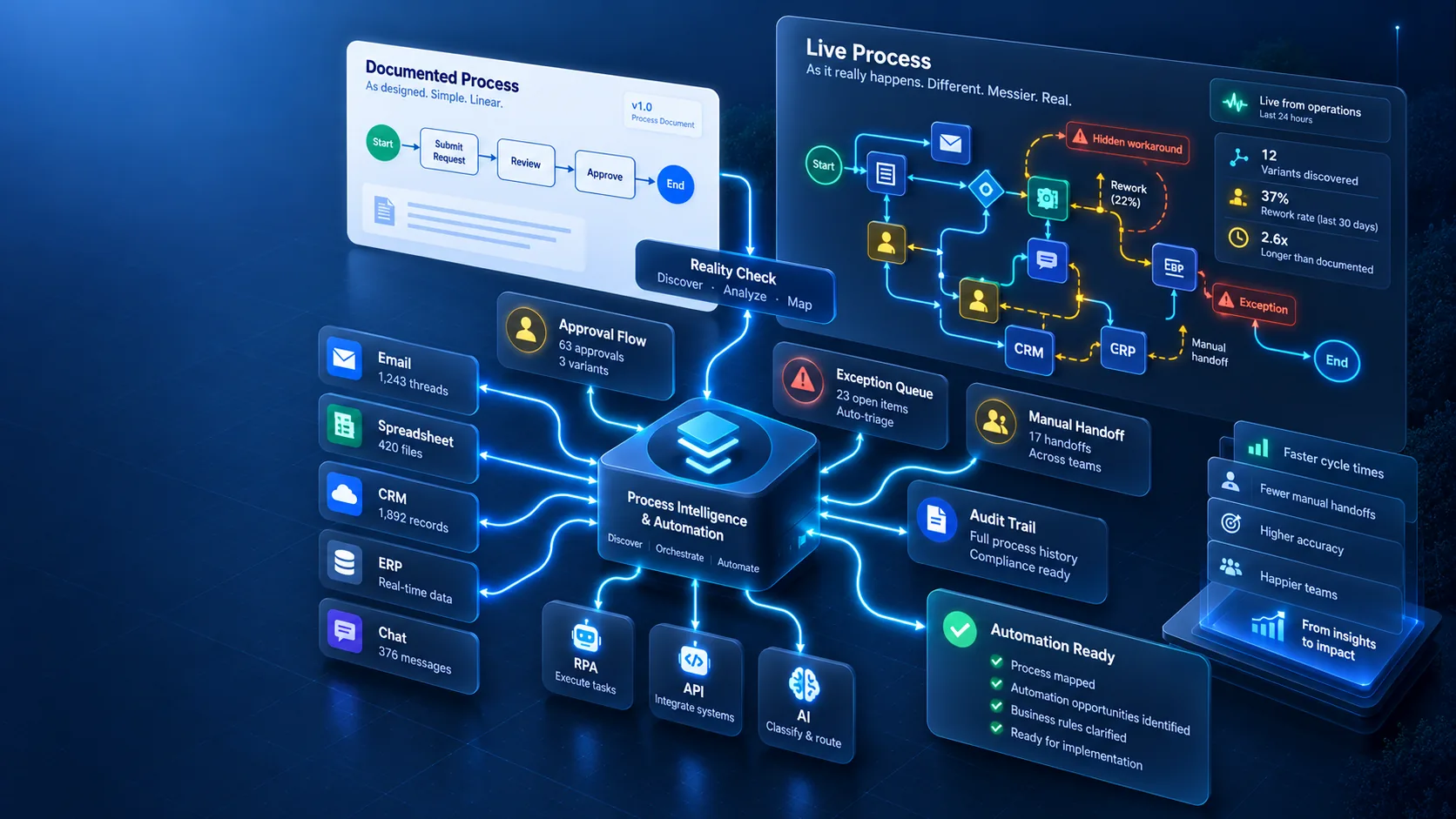
There is the version everyone agrees on and the version that actually runs, and the distance between them is where automation projects quietly die. We find the real one first, workarounds included, and automate that.
The gap
Ask three people how a process works and you get the chart. Watch it for a week and you get something longer, with a step that is skipped, a spreadsheet nobody mentions, and a workaround invented to get around a system that was replaced years ago. Both versions are real. Only one of them is what your business actually does, and automating the other produces something correct and useless.
Agreed in a meeting, accurate enough to explain to a new starter, and the version that gets handed to whoever is quoting for the automation.
Re-keying between two systems, a chase email, an approval that depends on who is in, and the cases that leave the path entirely. This is the one worth automating.
Capability
Six areas. Scope is agreed with you first, and a first engagement rarely needs all of it.
Before anything is automated, what actually happens - taken from the system logs and from watching the work, not from the flowchart. This is the step most often skipped and the one that decides whether the rest lands.
The whole path from trigger to outcome, rather than the one step that was easiest to script. Automating a fragment usually moves the manual work rather than removing it, and moves it somewhere less visible.
Invoices, forms, contracts and the attachments people email around. Reading them reliably enough to act on, with a confidence threshold below which a human still looks - because the alternative is confident nonsense at scale.
Who has to say yes, in what order, and what happens when they are on leave. Most approval chains are held together by somebody knowing who to chase, which works until that person is away.
The cases that do not fit the path: the missing field, the duplicate, the supplier who invoices differently. This is where automations actually fail, so it gets designed rather than discovered in production.
Power Automate, Make, n8n, Zapier or a custom engine, chosen by what your team can maintain and what your estate already has, not by preference. A tool nobody in the building can edit is a dependency, not an asset.
How we work
System logs, a few hours alongside the people doing the work, and the spreadsheet somebody keeps on their own machine. The real path is usually longer than the documented one and has branches nobody mentions.
Some steps are judgement, some carry a consequence too large to hand over, and some are just cheaper to leave alone. Deciding those out loud, early, is what stops the project becoming an argument later.
The high-volume, low-variation path first, wired into the systems already in use. Narrow and working beats broad and nearly working, and it gives everyone something real to react to.
Three stages in, the repeating work runs itself. The last two decide whether it survives a real week.
What happens when the field is blank, the system is down, the case is a duplicate or the amount is unusual. Every one of those needs a defined route and someone it lands with. Automations do not fail on the common case; they fail quietly on the uncommon one, and nobody notices for a fortnight.
The people who run the process should be able to change it without us: the thresholds, the routing, the wording. Documentation, training and the keys. A workflow only your supplier can edit is a process you no longer own.
Straight answer
This page used to carry one. It is gone, because a reduction figure quoted before anyone has looked at your process is a guess wearing a decimal point. What the number depends on is volume, how many of your cases are exceptions, and how much of the work is already digital rather than paper, email and re-keying - and those vary enormously between two companies doing ostensibly the same thing. So we measure what the process costs you now, before changing it, and the figure at the end is yours and measured rather than ours and advertised.
Before you ask
We will not put a number on that before looking, and you should be wary of anyone who does. It depends on the volume, on how many cases are exceptions, and on how much of the process is already digital rather than paper and email. What we will do is measure the baseline first, so the figure at the end is measured rather than claimed.
Usually a little, and it is worth saying plainly. Automating a process exactly as it is preserves every workaround that existed because a system was awkward ten years ago. We flag those and let you decide - some are load-bearing and some are habit, and the difference is not always obvious from the outside.
It goes to a defined place, not into a silence. Every automated path has an exception route, an owner and a record of what it was doing when it stopped. The point of the exception design is that a failure looks like a task in somebody queue rather than an invoice nobody paid.
Usually an automation. If the steps are known and the decision is a rule, a deterministic workflow is cheaper, faster, and gives the same answer every time - which is what you want for anything an auditor may ask about. Agents earn their place where the path genuinely varies and judgement is required; that work is on our AI Agent Development page, and we will say so if that is what you need.
Whichever one your team can still maintain in two years. Power Automate if you are a Microsoft estate, n8n or Make where the logic is more involved, a custom engine where the volume or the constraints justify it. The choice follows the people who will own it, and we will tell you when the answer is a tool we do not sell.
Next
The one with the spreadsheet, the chase emails and the step nobody can justify. Tell us what it is and roughly how often it runs, and we will come back with what could be automated, what should not be, and what it would take to find out properly.
Related white papers and articles for Business Process Automation will appear here as they're published.
View MoreGet in touch and we'll help you find the right approach.
Talk to Us