Travel

Intelligent
Tourism Solutions

Personalized Travel & Operations

Helping hotels, resorts, travel agencies, attractions, tourism organizations, and destination operators improve traveler experiences, optimize demand and revenue, automate service operations, and deliver more connected travel journeys through AI and digital technologies.

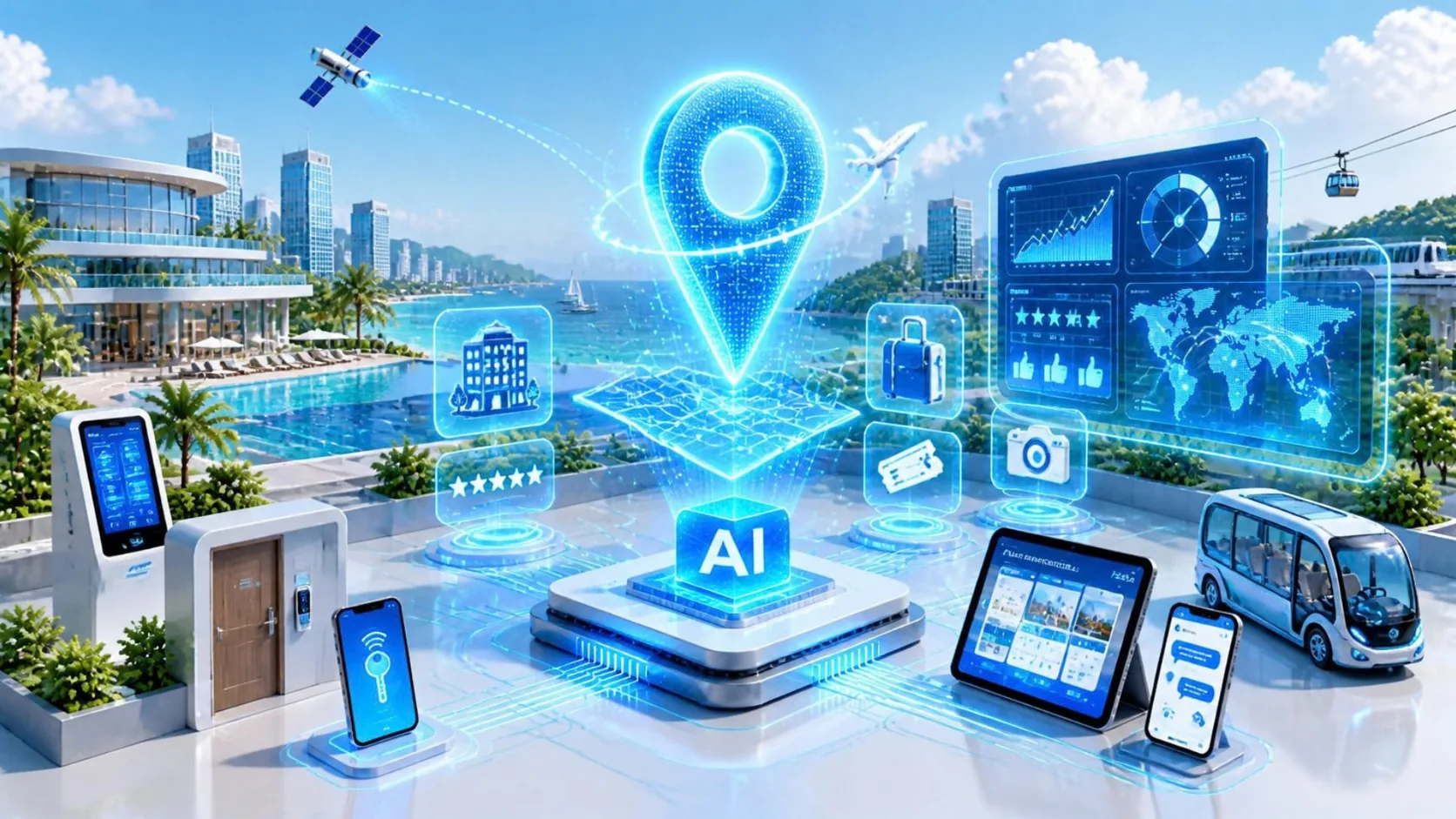
Illustration of connected, AI-assisted travel: a glowing holographic map pin above a travel map and an AI platform, with a plane on its orbit and hotel, review, luggage, ticket and camera tiles around it, linked by light trails to a seaside resort with a pool, a self check-in kiosk, a room door with a mobile key, a dashboard with demand, occupancy, review and route panels, a booking tablet, a concierge chat on a phone, a shuttle bus, a cable car and a train.
Industry Challenges

Key Challenges in Travel & Tourism

  1. Demand, Capacity & Revenue

    Travel demand changes rapidly by season, day, event, booking pace, market, and external conditions, making it difficult to balance pricing, availability, capacity, and profitability.

    • Demand forecasting
    • Occupancy & capacity
    • Pricing
    • Revenue management
  2. Traveler Experience, Communication & Reputation

    Travelers expect fast, personalized, multilingual support before, during, and after their trip, while reviews and digital experiences increasingly influence future booking decisions.

    • Personalization
    • Multilingual service
    • Guest support
    • Traveler feedback
  3. Booking, Distribution & Service Operations

    Disconnected booking channels, reservation systems, payments, customer communications, and administrative processes create unnecessary work and make the traveler journey harder to coordinate.

    • Reservations
    • Distribution channels
    • Ticketing
    • Service automation
  4. Operational Visibility, Assets & Destination Performance

    Tourism organizations need better visibility across facilities, operations, visitor behavior, service performance, and destination impact to maintain reliable experiences and make better long-term decisions.

    • Operational analytics
    • Asset reliability
    • Destination insights
    • Sustainable tourism
Opens in a new tab
Solutions

Technology Solutions for Travel & Tourism

Comprehensive capabilities to modernize travel experiences and tourism operations.

Discover → Plan → Book → Experience → Learn

Connecting the traveler's entire journey.

  1. Discover
    • Where should I go?
    • What should I see?
    • Which destination, hotel, attraction or experience fits me?
  2. Plan
    • When should I travel?
    • What should I include?
    • How should the itinerary fit together?
  3. Book
    • Accommodation.
    • Experiences.
    • Tickets.
    • Transportation.
    • Packages.
  4. Experience
    • Check-in.
    • Travel.
    • Local information.
    • Multilingual assistance.
    • Changes and disruptions.
  5. Learn
    • What did the traveler enjoy?
    • What caused friction?
    • What affected revenue?
    • What did reviews say?
    • What should the destination or business improve?

Use that information to improve the next traveler's journey.

Personalized Guest Experiences

Use AI to recommend destinations, activities, accommodations, dining, and travel experiences based on customer preferences and behavior.

Powered by AI Data & Analytics and Enterprise AI Solutions

Smart Booking & Reservation Systems

Modernize reservation management with integrated booking platforms, automated confirmations, payment processing, and CRM connectivity.

Powered by Custom Software Development and System Integration

AI Concierge & Virtual Assistants

Provide 24/7 multilingual support for reservations, travel planning, guest inquiries, room service, and local recommendations.

Powered by AI Agent Development

Dynamic Pricing & Revenue Management

Optimize pricing strategies using AI that analyzes demand, seasonality, competitor pricing, and booking trends in real time.

Powered by AI Data & Analytics

Smart Check-In & Guest Services

Improve arrival and departure experiences with digital check-in, mobile access, self-service kiosks, and automated guest communications.

Powered by Business Process Automation and System Integration

Reputation & Sentiment Analysis

Analyze guest reviews, surveys, and social media using AI to identify service improvements and strengthen brand reputation.

Powered by AI Data & Analytics

Business Analytics & Dashboards

Monitor occupancy, revenue, guest satisfaction, booking performance, and operational KPIs through real-time dashboards.

Powered by AI Data & Analytics

Process Automation

Automate reservations, customer communications, reporting, housekeeping coordination, invoicing, and administrative workflows.

Powered by Business Process Automation

Predictive Maintenance

Monitor hotel facilities and equipment using IoT sensors and predictive analytics to reduce downtime and improve guest comfort.

Powered by AI Data & Analytics and System Integration

Custom Travel Software Development

Develop booking platforms, tourism portals, mobile applications, loyalty programs, and integrated travel management systems tailored to your business.

Powered by Custom Software Development

Articles

Most Viewed Articles

AI Journey Guides

Explore AI for Tourism Step by Step

Practical guidance for tourism leaders — from understanding AI automation to evaluating traveler, operational, and destination readiness and moving into implementation.

  1. Step 01 Understand

    What Is AI Automation in Travel & Tourism?

    Understand how AI can support travel discovery, trip planning, reservations, guest communication, revenue management, tourism operations, and destination experiences.

  2. Step 02 Evaluate

    7 Key Success Factors for AI Automation in Tourism

    Learn what tourism organizations should evaluate before implementation, including traveler data, content accuracy, booking integration, multilingual service, revenue decisions, operational coordination, and customer trust.

  3. Step 03 Implement

    A Practical Guide to AI Implementation in Tourism

    Follow a practical path from selecting the right traveler or operational decision and connecting booking, customer, content, and destination data to piloting, deployment, measurement, and scale.

AI Journey Guides · Step 01 · Understand

What Is AI Automation in Travel & Tourism?

Travel begins long before a traveler arrives at a destination.

Someone first needs to decide:

  • Where should I go?
  • When should I travel?
  • What should I do there?
  • Which hotel fits my needs?
  • How much will the trip cost?
  • How do I connect transportation, accommodation, attractions, dining, and activities?

Then the journey begins.

  • Flights change.
  • Weather changes.
  • Plans change.
  • Travelers need information.
  • Hotels need to manage demand.
  • Attractions need to manage capacity.
  • Tourism organizations need to understand where visitors are going and what they are experiencing.

AI can help connect these decisions.

AI automation in Travel & Tourism combines traveler information, booking and availability data, operational systems, destination content, and intelligent automation to help organizations improve the journey before, during, and after travel.

The goal is not simply to add an AI chatbot to a tourism website.

It is to create a more connected travel experience.

The Intelligent Traveler Journey

A useful way to understand Tourism AI is:

  1. Discover

    Help travelers understand what is possible.

    • Where should they go?
    • What matches their interests?
    • What experiences are available?
  2. Plan

    Turn inspiration into a realistic trip.

    • When should they travel?
    • Where should they stay?
    • What should they do?
    • How should everything fit together?
  3. Book

    Connect the plan to real:

    • Availability
    • Pricing
    • Reservations
    • Tickets
    • Transportation
    • Accommodation
  4. Experience

    Support the traveler while the trip is happening.

    • Check-in
    • Local information
    • Recommendations
    • Multilingual assistance
    • Changes
    • Problems
    • Disruptions
  5. Learn

    Understand what happened.

    • What did travelers enjoy?
    • What caused friction?
    • Which services performed well?
    • What did reviews say?
    • What affected revenue?

Use those outcomes to improve the next journey.

That is the Tourism intelligence loop.

AI Travel Discovery

The traditional travel search process can require travelers to move between:

  • Search engines
  • Travel websites
  • Maps
  • Review platforms
  • Social media
  • Hotel websites
  • Attraction websites
  • Transportation websites

Each source provides part of the answer.

AI can help travelers combine those pieces into a more natural discovery process.

Instead of searching:

“Top tourist attractions in Kyoto”

a traveler might ask:

“I have three days in Kyoto with my parents. We enjoy traditional food and history, but one person cannot walk long distances. What would you recommend?”

That is a very different type of request.

The traveler is not simply looking for a list.

They are communicating:

Destination+Time+Interests+Mobility requirements+Travel companions

and expecting relevant options.

AI can help tourism organizations make their information easier to discover through these kinds of conversations.

Personalized Trip Planning

Travel planning contains many connected decisions.

A traveler may need to combine:

  • Accommodation
  • Transport
  • Attractions
  • Restaurants
  • Events
  • Activities
  • Travel time
  • Budget
  • Opening hours

AI can help organize these constraints.

For example:

Traveler
Three days in Tokyo.
Interests
Japanese food, anime, and traditional culture.
Budget
¥20,000 per day excluding hotel.
Requirement
Avoid excessive travel between areas.

An AI planning system could help organize an itinerary around geographically compatible experiences.

Instead of:

10 separate recommendations

the traveler receives:

A Connected Plan

  1. Morning
  2. Lunch
  3. Afternoon activity
  4. Hotel / rest
  5. Evening experience

This reduces the work required to transform inspiration into an actual trip.

Content Intelligence

AI travel planning depends on information.

That information might include:

  • Hotel descriptions
  • Room types
  • Attraction details
  • Opening hours
  • Ticket requirements
  • Prices
  • Location
  • Accessibility
  • Transportation
  • Events
  • Cancellation policies
  • Check-in rules

If the information is wrong, the AI can create a very convincing but very bad itinerary.

Imagine an assistant recommends:

  1. Visit the museum at 18:00.But the museum closes at 17:00.
  2. Take this train directly to the attraction.But that route no longer operates.
  3. This room is suitable for four guests.But the actual capacity is two.

Tourism AI therefore depends heavily on:

Content Truth

The underlying information needs to be:

  • Accurate
  • Current
  • Structured
  • Connected
  • Available to the systems using it

AI cannot compensate reliably for incorrect tourism information.

Intelligent Booking & Reservations

Planning and booking are different.

An AI system might recommend the perfect hotel.

But before anything can be booked, it needs to understand:

  • Availability
  • Dates
  • Room type
  • Price
  • Occupancy
  • Cancellation rules
  • Payment conditions

The same applies to:

  • Attractions
  • Tours
  • Tickets
  • Activities
  • Transportation
  • Restaurants

This creates an important distinction.

Discovery AIcan answer: “What might be good?”

But:

Transactional AIneeds to answer: “What can actually be booked right now?”

That requires connection to reservation and availability systems.

A useful booking flow might become:

  1. Traveler Request
  2. Suitable Options Identified
  3. Live Availability Checked
  4. Prices & Conditions Compared
  5. Traveler Confirms
  6. Reservation Completed

The closer AI gets to spending money or changing a confirmed itinerary, the more important accuracy, permissions, and traveler confirmation become.

AI Concierge & Traveler Assistance

Once the traveler arrives, their questions change.

Before travel:

“Where should I stay?”

During travel:

  • “How do I get there?”
  • “Is it open today?”
  • “Can I change my reservation?”
  • “What can I do nearby right now?”
  • “Where can I store my luggage?”

An AI concierge can help answer routine questions using current operational information.

For hotels, resorts, attractions, tour operators, and destination organizations, this can include:

  • Facility information
  • Opening hours
  • Directions
  • Reservations
  • Local recommendations
  • Service requests
  • Check-in information
  • Ticket information

The important principle is:

The AI should know the traveler context.

A generic answer is less useful than one that understands:

  • Where the traveler is
  • what they booked
  • when they are traveling
  • what services are actually available

Multilingual Tourism

Tourism naturally crosses languages.

A destination may serve visitors who speak dozens of languages.

AI can help organizations provide multilingual support across:

  • Websites
  • Digital concierge
  • Booking assistance
  • Attraction information
  • Customer support
  • Directions
  • Frequently asked questions

This can improve accessibility for international travelers.

But translation alone is not enough.

Tourism communication also needs context.

For example:

  • A phrase may be technically correct but culturally unnatural.
  • A transportation explanation may need different levels of detail for a first-time visitor.
  • An emergency situation may require extremely clear instructions.

The objective should therefore be:

Understandable Communication

not simply:

Automatic Translation

High-impact or sensitive situations should still have clear escalation to people.

Personalization During the Journey

Traveler preferences can also help tourism businesses create more relevant experiences.

Useful context might include:

  • Interests
  • Previous bookings
  • Travel purpose
  • Party type
  • Length of stay
  • Location
  • Time available
  • Budget
  • Previous interactions

For example:

  • A family traveling with children may need different recommendations from a solo business traveler.
  • A guest staying one night may need something nearby.
  • A traveler staying seven days may be interested in experiences farther from the main tourist areas.

AI can help move tourism from:

Same Recommendations for Everyone

toward:

Relevant Options for This Journey

But personalization should remain useful rather than intrusive.

Travelers should feel understood.

Not watched.

Revenue & Demand Intelligence

Tourism businesses also need to understand changing demand.

Demand may vary according to:

  • Season
  • Day
  • Events
  • Holidays
  • Weather
  • Booking pace
  • Market
  • Channel
  • Cancellation patterns

AI can help hotels, attractions, experiences, and other operators identify these patterns.

For example:

Historical Bookings+Current Booking Pace+Season+Major Event+Cancellation Pattern→Expected Demand

This can support decisions about:

  • Pricing
  • Capacity
  • Staffing
  • Promotions
  • Availability

The goal is not simply:

“Increase price when demand increases.”

Revenue decisions need to consider the wider travel experience, competitive position, customer expectations, and business strategy.

AI provides intelligence.

The organization determines the commercial strategy.

Smart Check-In & Service Operations

Tourism also contains many repetitive administrative processes.

For example:

  • Reservation confirmation
  • Check-in
  • Guest registration
  • Ticket validation
  • Service requests
  • Booking changes
  • Refund processing
  • Internal notifications

Intelligent automation can reduce repetitive work around these processes.

Consider hotel arrival.

Instead of:

  1. Guest arrives
  2. Information manually searched
  3. Documents checked
  4. Booking confirmed
  5. Standard information explained

some routine elements can be prepared before the guest reaches the desk.

That allows staff to focus more attention on:

  • welcome
  • exceptions
  • questions
  • hospitality

Like Restaurant AI, Tourism AI should automate friction rather than remove the human experience.

Travel Disruption & Exception Management

Travel does not always follow the plan.

A traveler may face:

  • Flight delays
  • Cancellations
  • Weather disruption
  • Missed connections
  • Attraction closures
  • Hotel changes
  • Transportation problems

These situations are difficult because one change can affect the rest of the itinerary.

Imagine:

  1. Flight delayed by four hours
  2. Hotel arrival changes.
  3. Airport transfer changes.
  4. Dinner reservation becomes impossible.
  5. Evening attraction ticket may be missed.

A sufficiently connected AI system could help identify these dependencies.

The future opportunity is not simply:

“Your flight is delayed.”

It is:

“Your Journey Has Changed — What Else Needs to Change?”

That is where AI agents become particularly interesting in travel.

AI Travel Agents

Traditional generative AI mainly helps people understand options.

An AI agent can potentially go further.

The progression looks like:

  1. Answer“Here are some hotels.”
  2. Recommend“These three appear to match your preferences.”
  3. Plan“Here is an itinerary using them.”
  4. Prepare“I found available options and prepared the booking.”
  5. Act“Complete the approved reservation.”

This creates a major distinction:

AI as AdviserversusAI as Actor

Travel is especially suited to this model because journeys contain many interconnected services.

But more autonomy also means stronger requirements for:

  • Permissions
  • Confirmation
  • Price accuracy
  • Booking conditions
  • Cancellation rules
  • Payment security
  • Error handling

The traveler should understand what the AI is authorized to do.

Reputation & Traveler Feedback

The traveler journey does not finish at checkout.

Tourism businesses receive feedback through:

  • Reviews
  • Surveys
  • Booking platforms
  • Social media
  • Customer-service messages

AI can help analyze this information at scale.

Imagine a hotel group receives thousands of reviews.

Instead of simply measuring:

Average score: 4.3

AI can identify themes such as:

Service
Staff friendliness.
Room
Cleanliness and comfort.
Location
Transport convenience.
Facilities
Pool, gym, restaurant, Wi-Fi.
Value
Price compared with experience.

Then management can ask:

“What is actually driving our reviews?”

The same approach can work for:

  • Attractions
  • Destinations
  • Tours
  • Visitor centers
  • Tourism campaigns

Traveler feedback becomes operational intelligence.

Destination Intelligence

Tourism does not only happen inside individual businesses.

Destinations also need to understand the movement and impact of visitors.

Useful information may include:

  • Visitor numbers
  • Locations
  • Transportation
  • Attractions
  • Accommodation
  • Events
  • Local spending
  • Facility use
  • Waste
  • Energy
  • Seasonal concentration

This can help tourism organizations understand:

  • Where visitors are going
  • When congestion occurs
  • Which areas receive little tourism
  • How visitors move
  • Where infrastructure is under pressure

For example:

A destination may discover that visitors are concentrated around two attractions during a narrow part of the day.

Instead of only promoting the destination more aggressively, the better decision may be to:

  • Recommend alternative experiences
  • Distribute visitors across times
  • Improve transportation information
  • Promote nearby areas

Tourism intelligence is therefore not only about increasing visitor numbers.

It can also help destinations manage tourism more effectively.

From Search to Connected Travel

The biggest change AI can bring to Tourism is connecting decisions that used to happen separately.

Today, the traveler may:

  1. Search for a destination.
  2. Open another website for hotels.
  3. Open another for transportation.
  4. Search attractions separately.
  5. Read reviews elsewhere.
  6. Create an itinerary manually.
  7. Book everything independently.

A more connected AI journey could become:

  1. Traveler Intent
  2. Destination Discovery
  3. Personalized Plan
  4. Availability
  5. Booking
  6. In-Trip Assistance
  7. Post-Trip Learning

Instead of optimizing one interaction, AI can help connect the entire traveler journey.

Before, During & After Travel

Tourism AI can also be understood across three periods.

  1. Before the Trip

    Discover, Plan & Book

    Help travelers:

    • Find destinations
    • Compare options
    • Build itineraries
    • Understand prices
    • Check availability
    • Make reservations
  2. During the Trip

    Experience & Adapt

    Help travelers with:

    • Check-in
    • Transportation
    • Recommendations
    • Local information
    • Reservations
    • Language
    • Changes
    • Disruptions
  3. After the Trip

    Learn & Improve

    Understand:

    • Reviews
    • Satisfaction
    • Complaints
    • Spending
    • Service performance
    • Traveler behavior
    • Destination impact

    Then improve the next journey.

This creates:

  1. Discover & Plan
  2. Book
  3. Experience & Adapt
  4. Learn
  5. Better Next Journey

AI Should Reduce Travel Friction

Travel contains many moments of friction.

  • Searching
  • Comparing
  • Waiting
  • Repeating information
  • Translating
  • Rebooking
  • Finding directions
  • Understanding policies

AI can reduce some of that friction.

But travel is also emotional.

People travel to:

  • relax
  • explore
  • celebrate
  • learn
  • visit family
  • experience another culture
  • create memories

The objective should not be:

Automate the Journey.

It should be:

Remove Friction Around the Journey.

Technology should make travel easier without making the experience feel mechanical.

Where Should a Tourism Organization Start?

Do not begin with:

“Where can we add AI?”

Start with one traveler or operational decision.

For example:

  • Which destination content should we recommend?
  • How can travelers build better itineraries?
  • How can we answer common questions faster?
  • Which booking requests could be automated?
  • How much demand should we expect next month?
  • Why are traveler ratings changing?
  • Where are visitors becoming concentrated?

Then ask four questions.

  1. 01Do We Have Reliable Information?Content? Bookings? Availability? Traveler data? Operations? Reviews?
  2. 02Is the Decision Repeated Often?Every search? Every booking? Every guest? Every day?
  3. 03Can AI Change an Action?Recommend? Plan? Book? Notify? Prioritize? Escalate?
  4. 04Can We Measure the Result?Conversion? Occupancy? Revenue? Response time? Guest satisfaction? Service workload? Visitor distribution?

If yes, there may be a strong AI automation opportunity.

The Goal: A Travel Journey That Learns

The most important opportunity is not simply an AI travel chatbot.

It is creating a connected intelligence layer across the traveler journey.

  1. 01DiscoverWhat is relevant to this traveler?
  2. 02PlanHow can the pieces fit together?
  3. 03BookWhat is actually available and confirmed?
  4. 04ExperienceWhat does the traveler need right now?
  5. 05LearnWhat worked, what created friction, and what should improve?

Better Next Journey

  • AI helps interpret traveler needs.
  • Automation connects those needs to services.
  • Tourism professionals provide hospitality, local knowledge, judgment, and real-world support.

Together, they can create journeys that are easier to discover, easier to organize, easier to experience, and continuously improved over time.

AI Journey Guides · Step 02 · Evaluate

7 Key Success Factors for AI Automation in Tourism

AI can help travelers discover destinations, build itineraries, compare options, make reservations, communicate across languages, manage changes, and receive more personalized support.

It can also help tourism organizations improve:

  • Demand forecasting
  • Revenue management
  • Booking operations
  • Guest communication
  • Destination marketing
  • Review analysis
  • Service coordination
  • Visitor management

But Tourism AI has a particular challenge:

A travel recommendation is only useful if the information behind it is accurate, available, bookable, and appropriate for the traveler.

  1. An AI assistant might recommend the perfect attraction.But what if it is closed?
  2. It might find the perfect room.But what if there is no availability?
  3. It might construct a beautiful itinerary.But what if the travel time between activities makes it impossible?
  4. It might answer a traveler in their language.But what if the meaning is technically translated yet operationally wrong?

The real question is therefore not:

“Do we have AI?”

It is:

“Can AI reliably connect traveler intent to real travel experiences?”

Before implementation, tourism organizations should evaluate seven factors.

Establish Traveler & Booking Truth

Tourism starts with understanding the traveler.

But traveler information often exists across separate systems.

A hotel may know:

  • Reservation details
  • Room type
  • Stay dates
  • Loyalty status

A booking platform may know:

  • Search behavior
  • Destination interest
  • Previous trips

An attraction may know:

  • Ticket purchases
  • Visit times
  • Party size

A tourism organization may know:

  • Markets
  • Visitor segments
  • Campaign interactions
  • Destination behavior

None of these alone represents the complete journey.

Before AI can personalize effectively, organizations should understand what traveler information is actually available and what it means.

For example:

A traveler searches for:

family activities

That does not automatically mean every future trip should be treated as a family trip.

They may later travel:

  • alone
  • for business
  • with friends
  • with different needs

Context matters.

A strong AI system distinguishes between:

Traveler ProfileLonger-term preferences.

and

Journey ContextWhat matters for this particular trip.

That journey context may include:

  • Destination
  • Dates
  • Budget
  • Party size
  • Travel purpose
  • Interests
  • Mobility requirements
  • Existing bookings
  • Transportation
  • Time available

This creates:

Traveler+Current Journey+Booking Context→Relevant Recommendation

The same principle applies operationally.

If the traveler asks:

“Can I check in early?”

the AI needs to know:

  • which property
  • which reservation
  • which date
  • which room

and potentially:

  • whether the request can actually be fulfilled

Without that context, personalization is mostly guesswork.

Create Content Truth

Travel AI depends heavily on content.

Hotels, attractions, transportation providers, destinations, and tourism operators maintain enormous amounts of information.

For example:

  • Property descriptions
  • Room types
  • Attractions
  • Activities
  • Ticket information
  • Operating hours
  • Locations
  • Accessibility
  • Photos
  • Policies
  • Check-in times
  • Cancellation rules
  • Events
  • Transportation information

If this information is inconsistent or outdated, AI can generate an excellent answer based on incorrect facts.

Imagine:

AI SaysThe attraction closes at 20:00.

RealityIt closes at 17:00 today.

Or:

AI SaysThe hotel provides airport transportation.

RealityThe service was discontinued six months ago.

Or:

AI SaysWheelchair access is available.

RealityOnly part of the facility is accessible.

These are not minor data-quality issues.

They can damage the traveler's actual journey.

Tourism organizations therefore need:

Content Truth

Information should be:

  • Accurate
  • Current
  • Structured
  • Consistent
  • Machine-readable

This is becoming increasingly important because travelers are no longer discovering tourism products only through traditional search engines.

AI-powered travel tools increasingly consume, compare, summarize, and recommend information on the traveler's behalf.

If tourism information cannot be understood reliably by those systems, even a strong tourism product may become harder for AI-assisted travelers to discover.

The principle is:

Good tourism AI starts with trustworthy tourism information.

Connect Recommendations to Real Availability

This is one of the biggest differences between AI for inspiration and AI for travel transactions.

An AI can recommend:

“Stay at Hotel A.”

That is easy.

But to make that recommendation actionable, the system may need to know:

  • Is the hotel available?
  • For which dates?
  • Which room type?
  • For how many guests?
  • At what price?
  • Through which booking channel?
  • Under which cancellation conditions?

The same applies to:

  • Tours
  • Attractions
  • Tickets
  • Transportation
  • Activities
  • Restaurants
  • Packages

Tourism AI therefore needs to distinguish between:

Possible“This experience exists.”

and

Available“This experience can actually be booked for this traveler at this time.”

This creates a much stronger travel flow:

  1. Traveler Intent
  2. Suitable Options
  3. Live Availability
  4. Price & Conditions
  5. Traveler Selection
  6. Booking

Without availability integration, the AI may create attractive but impossible journeys.

Connect the Whole Traveler Journey

Tourism information often exists in silos.

A traveler may interact with:

  • Destination website
  • Airline
  • Hotel
  • Railway
  • Travel agency
  • Attraction
  • Tour operator
  • Restaurant
  • Ticket platform
  • Visitor center

Each organization may understand only one part of the journey.

AI creates an opportunity to connect more of those moments.

Consider:

A traveler books a hotel.

Then later asks:

“What can I do near my hotel on Sunday morning before my 14:00 train?”

A useful AI assistant needs more than destination recommendations.

It may need:

Hotel location+Checkout time+Train departure+Travel time to station+Attraction opening hours+Traveler interests→Realistic Recommendation

This is Journey Integration.

The goal is not necessarily to build one giant system containing every tourism service.

Instead, systems need to exchange enough information to support the decision being made.

A useful model is:

  1. Discover
  2. Plan
  3. Book
  4. Prepare
  5. Experience
  6. Support
  7. Review

Each stage should be able to understand enough of the previous journey to avoid making the traveler start again.

The “Restart Problem” in Travel

Travelers often lose context when they move between services.

They might:

  1. research in one place
  2. compare in another
  3. book somewhere else
  4. receive confirmation by email
  5. manage the reservation in an app
  6. contact customer service through another system

At every transition, they may have to explain themselves again.

AI should help reduce this restart problem.

Instead of:

“Please tell us your booking number, destination, dates and request again.”

the system should already understand the appropriate journey context when permissions allow.

This is one of the biggest opportunities for intelligent tourism services:

Continuity

The traveler should feel like they are continuing one journey—not starting a new transaction every time they change channels.

Design for Language, Culture & Accessibility

Tourism operates across borders.

That means AI may need to support travelers across:

  • Languages
  • Cultural expectations
  • Different levels of travel experience
  • Accessibility requirements
  • Different communication styles

Translation is only the first layer.

Consider this traveler request:

“What is the easiest way to get from the airport to the hotel?”

An experienced traveler might want:

  • train names
  • platforms
  • transfers
  • fares

A first-time international visitor might need:

  • step-by-step instructions
  • where to buy the ticket
  • how long transfers take
  • whether luggage will be difficult
  • what signs to look for

Both travelers asked the same question.

Their information needs are different.

Tourism AI should therefore adapt not only:

What it communicatesbut sometimes:How it communicates.

Multilingual Does Not Mean Automatically Correct

AI translation can dramatically improve tourism accessibility.

But high-impact information requires greater care.

Examples include:

  • Visa requirements
  • Safety instructions
  • Cancellation conditions
  • Accessibility information
  • Emergency guidance
  • Allergen information
  • Transportation changes
  • Payment conditions

If an answer is uncertain, the system should not hide uncertainty behind confident language.

A useful model is:

  • TranslateRoutine information.
  • VerifyInformation where accuracy matters strongly.
  • EscalateSituations requiring human or authoritative support.

This creates a better balance between multilingual scale and traveler trust.

Define Trust, Permission & Service Boundaries

This factor becomes increasingly important as Tourism AI moves from:

AdvisertoActor.

There is a major difference between:

“Here are three hotels you may like.”and“I booked Hotel B for ¥85,000.”

The second action commits:

  • money
  • dates
  • cancellation conditions
  • part of the traveler's journey

AI autonomy therefore needs clear boundaries.

A useful progression is:

  1. InformProvide information.
  2. RecommendSuggest options.
  3. CompareEvaluate available choices.
  4. PreparePrepare a booking or change for traveler approval.
  5. ExecuteComplete an explicitly authorized action.
  6. EscalateTransfer unusual or sensitive situations to a person.

The appropriate level may vary by action.

For example:

AI might automatically provide:

hotel opening information

with very little risk.

But:

canceling a non-refundable reservation

requires much stronger confirmation.

Price Changes Need Special Attention

Travel pricing can change quickly.

Imagine:

AI recommends a room at:

¥22,000

The traveler continues through the conversation.

Five minutes later:

Actual price = ¥27,000

The system should clearly present the current transaction conditions before booking.

It should not behave as though the original price still applies.

The same is true for:

  • Ticket availability
  • Fare conditions
  • Cancellation fees
  • Taxes
  • Add-ons

The closer AI gets to transaction execution, the closer it needs to authoritative real-time systems.

Disruption Requires Stronger Boundaries

Disruption is another high-impact case.

Imagine a canceled flight.

The AI identifies an alternative.

But changing the flight may also affect:

  • Hotel arrival
  • Transfer booking
  • Attraction reservation
  • Train connection
  • Dining reservation

An advanced travel agent may eventually coordinate many of these changes.

But the system needs to know:

  • What may it change automatically?
  • What requires traveler approval?
  • What financial limit is permitted?
  • What happens when there is uncertainty?

This is why Tourism AI needs:

Permission Before Autonomy.

Current travel research shows why this distinction matters: travelers are substantially more comfortable using AI to generate ideas and compare options than allowing it to execute bookings or handle disruptions independently.

Prove Experience & Revenue Value

The final question is:

Did the traveler journey actually improve?

Tourism AI should not be judged only by:

  • Number of chatbot conversations
  • Number of recommendations
  • Number of AI-generated itineraries
  • Number of automated messages

Those are activity metrics.

The important measures depend on the use case.

Discovery

Measure:

  • Engagement
  • Relevant recommendation rate
  • Search-to-detail conversion
  • Destination/content discovery

Booking

Measure:

  • Conversion rate
  • Abandonment
  • Booking completion
  • Revenue
  • Average booking value

Customer Service

Measure:

  • Response time
  • Resolution time
  • Escalation rate
  • Repeated contact
  • Traveler satisfaction

Revenue Management

Measure:

  • Occupancy
  • Revenue per available capacity
  • Booking pace
  • Pricing performance
  • Cancellation behavior

Experience

Measure:

  • Guest satisfaction
  • Review sentiment
  • Complaint themes
  • Service recovery
  • Repeat visits

Destination Management

Measure:

  • Visitor distribution
  • Attraction congestion
  • Length of stay
  • Local spending
  • Seasonal balance
  • Infrastructure pressure

The objective depends on the organization.

A hotel may prioritize:
occupancy + guest experience.
An attraction may prioritize:
capacity + visitor satisfaction.
A travel agency may prioritize:
conversion + service efficiency.
A destination organization may prioritize:
visitor distribution + destination value.

There is no single Tourism AI metric.

Revenue Alone Is Not Enough

Tourism differs from many other industries because maximizing immediate demand is not always the best objective.

A destination could successfully attract more visitors and still create:

  • Congestion
  • Infrastructure pressure
  • Environmental stress
  • Poor resident experience
  • Poor traveler experience

The World Economic Forum's 2026 Tourism Index emphasizes that the sector's challenge is increasingly about managing growth, not simply generating more demand.

For destination-level AI, the objective may therefore become:

Better Visitor Value

rather than:

Maximum Visitor Volume

AI could help identify:

  • Overcrowded periods
  • Under-visited areas
  • Alternative attractions
  • Better visitor distribution
  • Transportation pressure
  • Seasonal imbalances

Tourism intelligence should support a healthier destination ecosystem.

The 7-Factor Tourism AI Readiness Test

Before implementation, ask these questions.

  1. Traveler & Booking TruthDo we understand the traveler, their current journey, and the reservations relevant to the decision?
  2. Content TruthAre our descriptions, schedules, policies, accessibility information, prices, and tourism content accurate and structured enough for AI to use reliably?
  3. Real AvailabilityCan AI distinguish between something that exists and something that can actually be booked now?
  4. Journey IntegrationCan discovery, booking, service, operational, and post-trip information connect without forcing the traveler to repeatedly restart?
  5. Language & Local FitCan the system communicate appropriately across languages, cultural contexts, accessibility needs, and traveler experience levels?
  6. Trust & PermissionIs it clear when AI may inform, recommend, prepare, transact, modify, or escalate?
  7. Experience & ValueCan we demonstrate improvement in traveler experience, booking performance, service efficiency, revenue, or destination outcomes?

The Tourism AI Readiness Chain

A strong Tourism AI capability connects:

  1. Traveler Context
  2. Content Truth
  3. Real Availability
  4. Journey Integration
  5. Language & Local Fit
  6. Trust & Permission
  7. Experience & Revenue Value

If one part is missing, the traveler journey can break.

For example:

Excellent personalization+outdated attraction information=a bad recommendation.

Perfect content+no live availability=a journey that cannot be booked.

Excellent AI planning+disconnected systems=the traveler still has to do all the work.

Strong automation+weak permissions=loss of traveler trust.

The model itself is only one part of Tourism AI readiness.

Example: Evaluating an AI Travel Planner

Imagine a destination organization wants to launch an AI trip-planning assistant.

Before implementation:

  1. Traveler ContextWhat does the assistant know? Dates? Interests? Budget? Mobility requirements? Party type?
  2. ContentAre attraction information, events, opening hours, accessibility, and transport details reliable?
  3. AvailabilityCan the assistant understand which experiences require reservations and whether they are available?
  4. Journey IntegrationCan it create an itinerary that accounts for travel time and existing bookings?
  5. LanguageCan international visitors understand the plan naturally?
  6. TrustDoes the traveler understand when the system is recommending versus booking?
  7. ValueMeasure: planning completion, engagement, referrals to tourism businesses, traveler satisfaction, and conversion where relevant.

Now the organization is evaluating a real tourism capability.

Not simply:

“Can AI generate an itinerary?”

Example: Evaluating an AI Hotel Concierge

Consider a hotel implementing an AI concierge.

The project might appear simple:

Let guests ask questions.

But operational readiness requires more.

The AI may need access to:

Hotel Information+Guest Reservation+Facility Availability+Local Information+Service Requests

The system also needs to know its boundaries.

For example:

  1. Inform“What time does breakfast start?”

    → AI answers directly.

  2. Request“Can I get two more towels?”

    → AI can create a service request.

  3. Recommend“Where should I eat nearby?”

    → AI can provide appropriate options.

  4. Modify“Move my checkout to 17:00.”

    → AI may need to check availability and policy.

  5. Escalate“My passport was stolen.”

    → The traveler likely needs appropriate human and authoritative assistance.

The value lies in knowing which level applies.

Example: Evaluating AI Revenue Management

A tourism operator might want AI-supported revenue management.

The system could analyze:

  • Historical bookings
  • Current booking pace
  • Season
  • Events
  • Weather
  • Cancellation patterns
  • Channels
  • Inventory

But readiness also means deciding:

  • Which prices can AI recommend?
  • Which prices can it change?
  • What limits exist?
  • Who reviews unusual changes?
  • What happens when demand changes unexpectedly?

The operating model becomes:

  1. Demand Signal
  2. Forecast
  3. Pricing Recommendation
  4. Commercial Boundary
  5. Approved Action
  6. Booking Result
  7. Learning

AI should support revenue strategy.

It should not become an uncontrolled pricing engine.

AI Visibility Is Becoming Part of Tourism Readiness

There is another emerging issue Tourism organizations need to consider.

Traditionally, digital visibility meant:

Can people find us through search?

Increasingly, another question matters:

Can AI understand and recommend us?

Travelers are beginning to use AI directly for discovery and trip planning.

Deloitte reports that nearly one-quarter of travelers surveyed were already using generative AI for trip planning by late 2025.

The World Economic Forum's September 2026 Tourism Index highlights the growing importance of keeping tourism information coordinated, accurate and machine-readable across AI-powered discovery and booking channels.

This means a tourism business may have:

  • a beautiful website
  • strong photography
  • excellent reviews
  • a valuable product

but AI systems may still struggle to understand:

  • What exactly is offered?
  • Who is it for?
  • When is it available?
  • Where is it?
  • What does it cost?
  • How can it be booked?

Tourism content now increasingly serves two audiences:

PeopleandAI Systems Helping People.

That should become part of Tourism digital strategy.

From Digital Tourism to Agent-Ready Tourism

Tourism organizations should also prepare for a gradual shift.

Digital Tourism

  • Traveler searches.
  • Traveler compares.
  • Traveler books.

AI-Assisted Tourism

  • Traveler asks AI.
  • AI discovers options.
  • AI compares them.
  • Traveler books.

Agentic Tourism

  • Traveler provides: preferences, budget, dates, and permissions.
  • AI coordinates multiple services.
  • Traveler approves important decisions.
  • AI helps execute the journey.

The shift does not happen overnight.

But organizations that structure their:

  • content
  • availability
  • APIs
  • booking systems
  • policies
  • permissions

will be much better positioned for it.

AI adoption in travel is already moving faster than many operators' readiness, while current research shows travelers are enthusiastic about assistance but remain more cautious when AI begins making consequential transactions on their behalf.

Before Moving to Implementation

A Tourism organization should be able to answer:

  • Do we understand the traveler and their current journey?
  • Can AI trust our tourism information?
  • Can recommendations connect to real availability?
  • Can information move across the traveler journey?
  • Can we serve international travelers appropriately?
  • Do we know exactly what AI is allowed to do?
  • Can we prove that the traveler experience or tourism business improved?

If those answers are clear, the organization has a much stronger foundation for moving from experimentation into implementation.

The next step is connecting those capabilities into a controlled real-world traveler journey.

AI Journey Guides · Step 03 · Implement

A Practical Guide to AI Implementation in Tourism

Implementing AI in Tourism is not simply about adding a chatbot to a travel website.

The traveler journey crosses:

  • Inspiration
  • Destination discovery
  • Trip planning
  • Booking
  • Transportation
  • Accommodation
  • Attractions
  • Local services
  • Customer support
  • Disruptions
  • Reviews

Each stage depends on different information and different systems.

That creates a difficult implementation challenge.

An AI system may generate an excellent recommendation.

  • But is the information correct?
  • Is the service available?
  • Can it actually be booked?
  • Does the traveler understand the conditions?
  • Is the AI allowed to make the transaction?
  • What happens when the journey changes?

A practical Tourism AI implementation should therefore connect:

  1. Traveler Intent
  2. Trusted Information
  3. Real Availability
  4. Appropriate AI Action
  5. Traveler Experience
  6. Learning

A useful implementation path is:

  1. Choose
  2. Connect
  3. Ground
  4. Design
  5. Test
  6. Pilot
  7. Integrate
  8. Measure
  9. Learn
  10. Scale

Choose One Journey Moment

Do not begin with:

“We need an AI tourism platform.”

Start with one traveler or operational decision.

For example:

Discovery
Help travelers find relevant destinations or experiences.
Planning
Help visitors build realistic itineraries.
Booking
Reduce friction when comparing or reserving services.
Customer Service
Answer common traveler questions more quickly.
In-Trip Support
Help travelers understand what to do nearby.
Revenue
Improve demand forecasting and pricing decisions.
Destination Management
Understand visitor movement and concentration.

The first AI project should solve a recognizable travel problem.

For example:

Help international travelers build realistic one-day itineraries using current attraction information, opening hours, and transportation time.

That is much stronger than:

Build an AI itinerary generator.

The goal is the journey outcome.

Not the AI feature.

Map the Traveler Journey Around the Decision

Once the use case is selected, understand the journey surrounding it.

Suppose a tourism organization wants to build an AI itinerary planner.

The actual traveler process may be:

  1. Traveler discovers destination
  2. Browses attractions
  3. Checks opening hours
  4. Looks at transportation
  5. Compares ticket prices
  6. Builds itinerary manually
  7. Makes reservations separately
  8. Adjusts plan during travel

The AI should not be designed as an isolated interface.

It should improve this journey.

Map:

  1. BeforeWhat does the traveler already know?
  2. IntentWhat are they trying to accomplish?
  3. InformationWhat facts are required?
  4. DecisionWhat choice needs to be made?
  5. ActionWhat happens after the recommendation?
  6. ExceptionWhat happens if something changes?
  7. OutcomeHow will success be measured?

That creates the foundation for implementation.

Connect the Authoritative Tourism Sources

Tourism AI needs reliable information.

Depending on the use case, that may come from:

  • Booking systems
  • Property management systems
  • Reservation platforms
  • Ticketing
  • Attraction databases
  • Destination content
  • CRM
  • Customer-service systems
  • Maps
  • Transportation information
  • Event data
  • Revenue systems
  • Review platforms
  • Internal policies

The important question is not:

“How much information can the AI access?”

It is:

“Which source is authoritative for this decision?”

For example:

  1. Opening HoursOfficial attraction information.
  2. Room AvailabilityReservation or property system.
  3. Reservation DetailsBooking system.
  4. Cancellation PolicyApproved commercial policy.
  5. Traveler ProfileAuthorized customer system.
  6. Ticket AvailabilityTicketing platform.

A Tourism AI system should know where truth comes from.

Create a Tourism Content Layer the AI Can Trust

Tourism content is often designed for humans.

AI also needs structure.

Imagine an attraction page containing beautiful marketing copy but no clearly structured information about:

  • Opening hours
  • Location
  • Duration
  • Accessibility
  • Ticket requirements
  • Age restrictions
  • Price
  • Reservation rules

A person might interpret the page.

An AI system may struggle to use it consistently.

Tourism organizations should therefore structure critical information around clear entities.

For example:

Attraction

  • Name
  • Location
  • Category
  • Opening hours
  • Expected duration
  • Price
  • Reservation requirement
  • Accessibility
  • Available languages
  • Seasonality

Hotel Room

  • Property
  • Room type
  • Occupancy
  • Amenities
  • Availability
  • Price
  • Cancellation condition
  • Check-in / check-out

The objective is not simply better databases.

It is:

Making tourism information understandable to both people and AI.

Separate Content From Availability

This distinction is essential.

A tourism product can exist without being available.

For example:

A guided tour exists.

But:

  • not on Tuesday
  • not at 16:00
  • not for six people
  • not during winter

Therefore:

Contentdescribes what something is.

while:

Availabilitydetermines whether the traveler can use it now.

The AI architecture should preserve this distinction.

For example:

  1. Traveler asks for a cultural experience
  2. AI finds suitable experiences.
  3. Live availability is checked.
  4. Only valid options are presented.
  5. Price and conditions are confirmed.

This prevents the system from creating attractive but impossible recommendations.

Design the AI Around Traveler Intent

Travelers rarely speak in database fields.

They say:

  • “I want somewhere relaxing near Tokyo for two nights.”
  • “My parents cannot walk very far.”
  • “We want something traditional but not too touristy.”
  • “I have four hours before my train.”

The AI's role is to translate human intent into relevant travel constraints.

For example:

  1. 01Traveler Request“Three days in Kyoto with elderly parents.”
  2. 02AI Interprets
    • Duration = 3 days
    • Mobility = limited
    • Interest = culture
    • Pacing = relaxed
  3. 03Tourism Systems Provide
    • Attractions
    • Opening hours
    • Transport
    • Accessibility
    • Reservation requirements
  4. 04AI ProducesA realistic itinerary.

This is one of Tourism AI's biggest strengths.

But the underlying operational information still needs to remain authoritative.

Decide What Level of Authority the AI Has

Tourism AI can operate at several levels.

  1. InformAnswer questions.

    Example: “Breakfast is served from 7:00 to 10:00.”

  2. RecommendSuggest appropriate options.

    Example: “These three attractions match your interests.”

  3. PlanCombine multiple options into an itinerary.
  4. PreparePrepare a reservation or change for approval.
  5. ExecuteComplete an explicitly authorized transaction.
  6. RecoverHelp modify the journey when something goes wrong.

These levels should not be treated as equivalent.

A useful Tourism rule is:

More Consequence = More Control

Providing directions requires relatively little authority.

Canceling a non-refundable hotel reservation requires much more.

Build a Traveler Permission Model

Before allowing AI to act, define what the traveler has authorized.

For example:

  1. Level 1 — InformationAI may access public tourism information.
  2. Level 2 — PersonalizationAI may use approved traveler preferences.
  3. Level 3 — Booking ContextAI may access relevant reservations.
  4. Level 4 — Prepare ActionAI may prepare changes or transactions.
  5. Level 5 — Execute ActionAI may perform explicitly authorized actions within defined limits.

This becomes especially important for agentic travel.

Suppose a flight is canceled.

The traveler might authorize:

“Find me another flight under ¥30,000 and prepare the change, but ask me before purchasing.”

That permission is very different from:

“Automatically rebook anything.”

AI autonomy should match traveler intent.

Test With Real Traveler Scenarios

Do not test Tourism AI only with simple questions.

Real travelers are messy.

  • They change their minds.
  • They misunderstand destinations.
  • They mix several constraints.
  • They ask incomplete questions.

Testing should include realistic scenarios.

For example:

Family
Two adults and two children. Limited budget. Rain expected.
Elderly Traveler
Limited walking. Needs elevator access.
International Visitor
Does not speak the local language. First visit to Japan.
Business Traveler
Only four free hours. Must return to hotel by 18:00.
Last-Minute Traveler
Tomorrow arrival. Very limited availability.
Accessibility Need
Requires verified wheelchair accessibility.

The test should ask:

  • Was the answer accurate?
  • Was the itinerary realistic?
  • Was travel time included?
  • Were opening hours respected?
  • Was availability checked?
  • Were limitations communicated?

Test Failure Scenarios Too

A Tourism AI system must also know what to do when the journey breaks.

Test:

  • Attraction closed unexpectedly
  • Hotel sold out
  • Ticket price changes
  • Train disrupted
  • Weather changes
  • Reservation cannot be found
  • Traveler misses connection
  • Booking API fails
  • Information conflicts
  • Requested experience does not exist

A strong system should not invent a solution.

It should know when to say:

This information cannot currently be confirmed.

or:

A person needs to help with this request.

Tourism AI needs graceful failure.

Test Multilingual Journeys

Do not simply translate one English test set.

Create realistic scenarios in the languages travelers actually use.

Check:

  • Meaning
  • Tone
  • Location names
  • Transportation instructions
  • Dates and times
  • Prices
  • Policies
  • Cultural context
  • Accessibility information

A translation may be grammatically correct while still being operationally confusing.

For example, a first-time traveler may need:

  • Which station entrance?
  • Which platform?
  • Does the train require a reservation?
  • Can luggage fit?

The quality standard should be:

Can the traveler actually complete the journey?

Not merely:

Was the sentence translated?

Pilot One Controlled Journey

Do not immediately deploy across every destination and traveler interaction.

Choose a defined scope.

For example:

AI Hotel Concierge
One property. Common guest questions only.
AI Itinerary Planner
One city. Selected attractions.
AI Revenue Management
One hotel or experience category.
AI Destination Assistant
One tourism website.
AI Ticketing Support
One attraction.

A controlled pilot makes evaluation possible.

Example:

Pilot — AI destination planner

Scope
Tokyo cultural experiences
Travelers
English-speaking visitors
Capability
Discovery + itinerary planning
No Autonomous Booking
Recommendations only
Measures
Plan completion, engagement, accuracy, referral clicks, traveler satisfaction, support escalation

Now there is a clear operational experiment.

Use Shadow Mode Before Automated Transactions

For more consequential systems, the AI can first operate without taking action.

Imagine a revenue-management system.

The AI generates:

Recommended price

but management continues making the actual pricing decision.

Then compare:

AI Recommendationvs.Human Decisionvs.Booking Result

The same method can work for:

  • Reservation changes
  • Traveler support
  • Rebooking
  • Capacity allocation
  • Tourism marketing

This allows organizations to understand how AI behaves before increasing its authority.

Integrate Into the Existing Traveler Journey

AI should not create another disconnected tourism channel.

A traveler might already use:

  • Website
  • Mobile app
  • Email
  • Booking portal
  • Messaging
  • Hotel front desk
  • Visitor center

The AI should preserve journey context across appropriate channels where possible.

Imagine:

A traveler builds an itinerary online.

Later they open the destination app.

The useful experience is:

“Continue your Kyoto itinerary?”

Not:

“Hello. What city are you visiting?”

This is the difference between:

AI ConversationandAI Journey Continuity

Continuity is where much of Tourism AI's real value appears.

Design the Human Handoff

Some traveler situations should move to people.

Examples include:

  • Emergency
  • Lost passport
  • Serious complaint
  • Payment dispute
  • Complex accessibility request
  • Safety concern
  • Unclear booking condition
  • Major itinerary disruption

The handoff should preserve context.

Bad experience:

  1. AII cannot help. Contact support.
  2. Then: HumanPlease explain your problem again.

Better experience:

  1. AI Conversation
  2. Relevant Journey Context
  3. Booking Information
  4. Problem Summary
  5. Human Agent

The traveler should not have to restart the entire story.

Protect the Booking Moment

The booking moment deserves special controls.

Before a transaction is completed, confirm:

  • Exact product
  • Date
  • Time
  • Travelers
  • Current price
  • Taxes where applicable
  • Cancellation conditions
  • Important restrictions
  • Final traveler approval

A recommendation may use approximate information.

A transaction cannot.

The closer AI gets to payment, the more important real-time verification becomes.

A practical rule is:

Recommend From Intelligence.

Transact From Authoritative Systems.

Build for Journey Changes

Travel is unusually dynamic.

Plans change after booking.

A useful Tourism AI architecture should therefore understand dependencies.

Consider:

  1. Flight Delay
  2. Airport transfer affected.
  3. Hotel arrival time changes.
  4. Dinner reservation affected.
  5. Evening activity may become impossible.

Future travel agents may help coordinate these dependencies.

But even a simpler implementation can provide value by identifying them.

The system might say:

“Your new arrival time may conflict with your airport transfer and dinner reservation. Would you like me to check alternatives?”

That is much more valuable than treating each booking independently.

Measure the Traveler Journey

Do not measure only AI usage.

Measure what changed for the traveler or organization.

Discovery

  • Relevant recommendations
  • Engagement
  • Content discovery
  • Journey continuation

Planning

  • Itinerary completion
  • Planning time
  • Recommendation acceptance
  • Plan feasibility

Booking

  • Conversion
  • Abandonment
  • Booking value
  • Booking completion

Service

  • Response time
  • Resolution rate
  • Human escalation
  • Repeated contact

Experience

  • Satisfaction
  • Review sentiment
  • Complaints
  • Service recovery

Revenue

  • Occupancy
  • Booking pace
  • Yield
  • Revenue performance

Destination

  • Visitor distribution
  • Length of stay
  • Seasonality
  • Local spending
  • Congestion

The correct metric depends on the problem being solved.

Measure Trust

Tourism AI also needs trust metrics.

For example:

  • How often are recommendations rejected?
  • How often does the traveler ask for verification?
  • How often does AI need to correct itself?
  • How often are transactions abandoned after AI assistance?
  • How often does a person need to intervene?
  • Which types of recommendations generate complaints?

A technically correct system can still fail if travelers do not trust it.

Trust is therefore not a soft concept.

It is part of operational performance.

Learn From the Journey Outcome

The learning loop should connect:

  1. Traveler Intent
  2. AI Recommendation
  3. Traveler Choice
  4. Booking
  5. Actual Experience
  6. Feedback
  7. Better Future Recommendation

For example:

  • AI recommends three attractions.
  • The traveler selects one.
  • Later the traveler gives the experience a high rating.

That becomes a useful outcome signal.

But organizations should be careful not to assume that:

No booking = bad recommendation

because many external factors can influence traveler behavior.

Tourism learning needs context.

Keep Tourism Information Current

Tourism information changes frequently.

Examples include:

  • Opening hours
  • Seasonal operations
  • Prices
  • Events
  • Transportation
  • Construction
  • Availability
  • Policies

A strong AI system therefore needs content maintenance.

Define:

  • Who owns each information source?
  • How often does it update?
  • How does the AI know something changed?
  • What happens when sources conflict?

This should become part of normal tourism content operations.

AI makes outdated information more dangerous because it can distribute that information confidently and at scale.

Prepare for AI Discovery

Tourism organizations increasingly need to think beyond traditional web search.

Travelers may ask an AI assistant:

“Find me a quiet traditional hotel near Kyoto with private baths and easy station access.”

The AI decides which tourism information to retrieve and interpret.

Organizations should make important content:

  • Clearly structured
  • Current
  • Consistent
  • Accessible
  • Descriptive
  • Connected to authoritative booking information

The future question is increasingly:

Can AI Understand Our Tourism Product?

Not only:

Can Google Find Our Website?

This should become part of Tourism digital strategy.

Prepare for AI Agents

Once the information and integration layers are reliable, tourism organizations can gradually support more agentic interactions.

A maturity path could look like:

  1. Stage 1 — AnswerProvide trusted tourism information.
  2. Stage 2 — RecommendPersonalize options.
  3. Stage 3 — PlanConnect several services into a journey.
  4. Stage 4 — PreparePrepare bookings and changes.
  5. Stage 5 — TransactExecute authorized actions.
  6. Stage 6 — CoordinateManage multiple connected parts of the journey.

The mistake would be jumping directly to Stage 6 without reliable content, availability, permissions, and transaction systems.

Agentic Tourism should be built on operational readiness.

Scale Across Channels

Once the capability works, expand it carefully.

An AI tourism assistant might begin on:

Website

then extend to:

  • Mobile app
  • Messaging
  • Visitor center
  • Hotel room interface
  • Customer-service tools

The intelligence can remain common while the interface changes.

This creates:

One Tourism Intelligence LayersupportingMultiple Traveler Channels.

That is much more scalable than building a separate AI system for every touchpoint.

Scale Across Tourism Partners

Destination-level AI becomes more useful when it can understand multiple parts of the tourism ecosystem.

For example:

  • Hotels
  • Attractions
  • Transport
  • Events
  • Restaurants
  • Tourism organizations

But each partner may use different systems and data formats.

Scaling therefore requires:

  • Shared data definitions
  • Reliable APIs
  • Content standards
  • Permission rules
  • Partner governance

The goal should not be one giant central database.

It should be enough interoperability for traveler journeys to work.

Example: Implementing an AI Destination Planner

Consider a destination organization launching an AI itinerary planner.

  1. 01ChooseHelp international visitors build realistic itineraries.
  2. 02Connect
    • Attractions
    • Events
    • Transportation
    • Opening hours
    • Accessibility
    • Location data
  3. 03GroundIdentify authoritative sources for each type of information.
  4. 04DesignUnderstand traveler:
    • dates
    • interests
    • budget
    • mobility
    • party type
  5. 05TestUse realistic traveler scenarios.
  6. 06PilotOne destination and selected experiences.
  7. 07Measure
    • Planning completion
    • Accuracy
    • Traveler satisfaction
    • Referral activity
  8. 08LearnAnalyze which recommendations travelers accept and how the trip actually performs.
  9. 09ExpandAdd more content, languages, booking connections, and destinations.

The important point is:

The goal is not

generating itineraries.

It is

generating itineraries travelers can actually use.

Example: Implementing an AI Hotel Concierge

A hotel could follow a different path.

  1. 01ChooseReduce repetitive guest-service requests.
  2. 02Connect
    • Property information
    • Reservation data
    • Facilities
    • Service requests
    • Local information
  3. 03Define Authority
    • Answer FAQs.
    • Create routine service requests.
    • Recommend nearby experiences.
    • Escalate sensitive cases.
  4. 04PilotOne property.
  5. 05Measure
    • Response time
    • Resolution rate
    • Guest satisfaction
    • Human workload
  6. 06Expand
    • More languages.
    • More services.
    • More properties.

The hotel should gradually increase capability based on evidence rather than trying to automate the entire guest relationship immediately.

Example: Implementing AI Revenue Management

For revenue management:

  1. 01Signals
    • Historical bookings
    • Booking pace
    • Seasonality
    • Events
    • Weather
    • Cancellations
    • Channel behavior
  2. 02ForecastExpected demand.
  3. 03RecommendPricing or inventory action.
  4. 04Commercial BoundaryApproved minimums, maximums, rules, and exceptions.
  5. 05Human or Automated ActionDepending on authority level.
  6. 06Result
    • Bookings
    • Revenue
    • Occupancy
    • Cancellation behavior
  7. 07LearningImprove future recommendations.

The AI should operate inside commercial strategy.

It should not replace commercial governance.

The Tourism AI Implementation Path

The complete implementation path can be summarized as:

  1. ChooseSelect one traveler or operational decision.
  2. ConnectIdentify the booking, content, customer, availability, and operational systems required.
  3. GroundDefine authoritative sources for every important fact.
  4. DesignTranslate traveler intent into usable context and clear AI authority.
  5. TestValidate normal, multilingual, accessibility, and failure scenarios.
  6. PilotDeploy within one controlled journey, property, attraction, or destination.
  7. IntegrateConnect AI to the channels and workflows travelers already use.
  8. MeasureEvaluate experience, trust, operational, and commercial results.
  9. LearnConnect recommendations and actions to actual traveler outcomes.
  10. ScaleExpand across channels, languages, partners, destinations, and gradually increasing levels of AI autonomy.

From Tourism AI to Connected Journeys

The goal is not simply:

An AI travel assistant.

The larger opportunity is creating a connected tourism environment where intelligence can support the traveler throughout the journey.

  1. 01DiscoverUnderstand what the traveler wants.
  2. 02PlanConnect relevant experiences.
  3. 03BookCheck real availability and conditions.
  4. 04ExperienceSupport the traveler in context.
  5. 05AdaptRespond when the journey changes.
  6. 06LearnUnderstand what worked and what created friction.

Improve the Next Journey

  • AI provides intelligence.
  • Tourism systems provide authoritative information and transactions.
  • Tourism professionals provide hospitality, judgment, local expertise, and exception handling.

Together, they can create travel experiences that are easier to discover, easier to plan, easier to book, and easier to navigate.

The Key Principle

A Tourism AI system should always be able to answer three questions:

  1. 01Is It True?Is the information reliable?
  2. 02Is It Available?Can the traveler actually use or book it?
  3. 03Is It Authorized?Is the AI allowed to take this action?

When those three conditions are satisfied, AI can move much more safely from:

  1. information
  2. recommendation
  3. action

That is the foundation of practical AI implementation in Tourism.

Ready to Transform Your Travel Business?

Every tourism organization has different travelers, booking channels, services, facilities, and destination priorities. Robo Lab can help identify where AI and automation can improve traveler experiences, revenue decisions, service operations, and destination performance.

Talk to Our Team Explore AI Solutions