White Papers & Articles
Related white papers and articles for Custom Software Development will appear here as they're published.
View MoreCustom Software Development
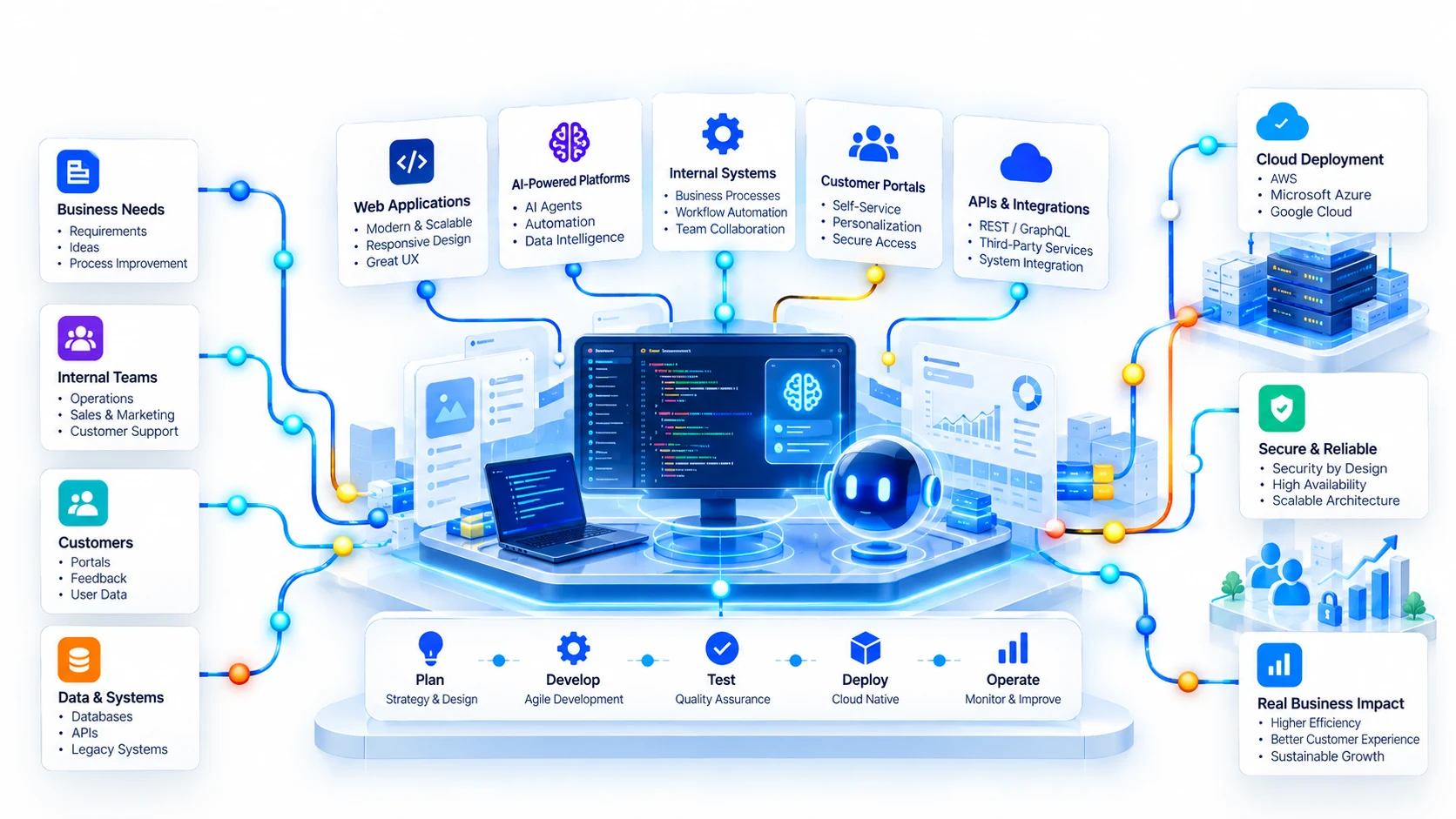
Web applications and portals, AI-powered platforms, APIs, internal and ERP tools, cloud-native services. Built so the team that inherits them can change them without calling us.
The real cost
A build has an end date and a number attached to it, which is why it is the part everyone compares. What comes after has neither: the changes nobody scoped, the dependency that stops being maintained, the one person who understood it leaving. That is not a risk of custom software - it is what custom software is, and it is mostly decided by how the first version was written.
A bounded system in your stack, with tests that say what it does and a handover that assumes we will not be here. The interesting engineering is in what happens after we leave.
Clever where it did not need to be, undocumented, and deployed by a process one person knows. It looks like good value on delivery and it is a tax for as long as you run it.
Capability
Six areas. Not every engagement needs all of them, and the scope is agreed with you before anything starts.
The systems your customers and your staff sign in to. Most of the difficulty is not the screens: it is accounts, permissions, state that has to survive a refresh, and what happens on the slow connection you cannot reproduce at your desk.
A product with a model somewhere inside it, rather than an AI project with an interface bolted on afterwards. What the model does is usually the smallest part of the work; everything around it decides whether the thing can be operated.
REST and GraphQL endpoints, built to be consumed by people who will not read your documentation. Versioning and error shapes get decided at the start, because they are close to impossible to change once anything depends on them.
The systems nobody demos and everybody uses. They are judged on a different axis from customer software: not whether it delights, but whether the person doing the job for the fortieth time that day is fighting it.
Containerised services, deployed repeatably, sized to what you actually run. Kubernetes when the shape of the problem justifies it, and plainer infrastructure when it does not - which is more often than it is offered.
Readable code, decisions written down, a test suite and a deployment anybody on your team can run. This is a deliverable rather than a courtesy, and it is the one that decides what year two costs.
How we work
Usually the most valuable hour of the engagement. Most requirements lists contain something that already exists as a product, and building it is the most expensive way to obtain it.
One path through the system, end to end, running in your environment. It settles the arguments that cannot be settled on a whiteboard, and it settles them before the budget is committed.
Your cloud, your repository, your identity provider, your review process. Not ours, not a sandbox, and not somewhere that has to be migrated to you at the end.
Three stages in, it runs in your environment. The last two are what make it yours rather than ours.
Tests that describe what the system is supposed to do, running on every change. Without them a handover is a hope: the next person cannot tell whether what they changed broke something two screens away.
Documentation written for whoever maintains it rather than for us, a deployment your team runs themselves, and the parts that are inconvenient for us to give up. The engagement is designed to end.
Straight answer
If a product already does most of what you are describing, the honest advice is to buy the product and spend the difference on the part that is genuinely yours. Custom software earns its keep in a narrow place: where an off-the-shelf tool would force you to change the thing that actually makes you money. Everywhere else it is a bill you have chosen to keep paying, and we would rather talk you out of it than write it.
Before you ask
Ask us before you have decided rather than after. If a product already covers the work you are describing, buying it is cheaper twice over: the licence costs less than the build, and you are not the one maintaining it afterwards. The cases worth building are the ones where an off-the-shelf tool would make you change how the business actually works.
React and Next.js at the front, Node.js or Python with FastAPI behind it, PostgreSQL for data, Docker and Kubernetes where the deployment justifies them. The list matters less than the reason for it: this is a stack your team can hire for and read, which is a constraint we apply on purpose rather than a preference we happen to have.
The source is in your repository under your licence, the deployment runs from your pipeline, and the documentation is written for whoever inherits it. If your engineers cannot change the system without calling us, the handover failed, whatever the invoice said.
Web Design is the surface - the type scale, the spacing, the hierarchy, how it reads. This is what sits behind it: accounts, data, permissions, APIs, deployment. Most real projects want both, and they are separate pages because they are separate skills and you may only need one. Web Design.
Usually, and we would rather do that than start again. The rewrite is the most frequently proposed and least frequently justified answer in this industry. What we will do first is read what you have and tell you which parts are worth keeping - sometimes that is most of it, which is a cheaper answer than the one you were expecting.
Next
Send us what you were going to build. We will come back with what is worth building, what already exists as a product, and what the first slice should be - which is usually smaller than the list.
Related white papers and articles for Custom Software Development will appear here as they're published.
View MoreGet in touch and we'll help you find the right approach.
Talk to Us