White Papers & Articles
Related white papers and articles for Global Digital Talent will appear here as they're published.
View MoreGlobal Digital Talent
AI and machine learning engineers, full-stack developers, automation specialists, UI/UX designers and dedicated teams, for organizations worldwide - working inside your team, your tools and your reviews, so what they learn stays with you.
The real constraint
A capable engineer who does not yet know your codebase, your customers or why the last few decisions were made is, for a while, a cost rather than capacity: someone on your team spends their time explaining instead of building. That is true of every new hire, and truer of someone outside the building. So the work is less about finding people - there are capable people in every time zone - and more about how quickly they can do useful work inside your team, and whether what they learn is still there when they leave.
They work in your repository, your tracker and your meetings, and their work is reviewed the way your own engineers’ is. Nothing is built somewhere you cannot see and handed over at the end.
Work that disappears into another organization and comes back as a delivery. It feels efficient until something needs to change and nobody on your side knows how it was built.
Capability
Six kinds of role, alone or combined. Which you need depends on the gap in your team, not on what we would like to place.
Engineers who build with models rather than only calling them: retrieval, evaluation, and the plumbing around a model that decides whether it can be run in production, not only demonstrated.
Front end to database, in the stack you already run. The useful ones read your existing code before they write new code, and leave it easier for the next person to read.
People who make repeated work stop being manual - workflows, scripts, integrations - and who ask first whether the step should exist at all.
Research, flows and interface design, working alongside your engineers from the start rather than handing over pictures at the end.
A small team working on one thing for you over time, inside your process, with a lead of its own. The point of a dedicated team is continuity: the same people, accumulating the same context.
Someone who owns the plan, the risks and the conversation with your stakeholders, so the engineers spend their time engineering and you always know where things stand.
How we work
What your team cannot do yet, or cannot do fast enough, and why. Sometimes the gap is a skill and sometimes it is time. Sometimes it is a decision nobody has made, and no hire fixes that.
Before anyone starts, you meet them and decide for yourself. A list of skills says what someone has done; a conversation about your actual problem says whether they will be useful on it.
Access, a small first task, and a named person on your side to ask. The first weeks decide whether someone becomes capacity or stays a cost, so they are planned rather than left to chance.
Three stages in, they are doing useful work inside your team. The last two keep it useful - and keep it yours.
In your repository, your tracker, your reviews and your meetings. If you cannot see the work as it happens, you are not managing it - you are waiting for it.
Decisions written down, code reviewed by your own people, and a handover that assumes the engagement will end. When someone moves on, what they learned should not leave with them.
Straight answer
It is one of the oldest findings in software, and it still holds: adding people to work that is already behind usually slows it further, because the people who know the work stop to teach it. If a deadline is the problem, the honest options are usually less scope or more time. We will say that before we suggest adding anyone - and bring people in when the gap is genuinely capacity, early enough for them to help.
Before you ask
With a project you buy an outcome, and someone else decides how it is built. Here you add people to your own team and keep every decision, which suits work that is ongoing and close to how your business runs. If what you want is a finished system built for you, that is a different service: Custom Software Development.
Individuals when the gap is a skill your team lacks; a team when it is a whole stream of work nobody owns. A dedicated team still needs someone on your side to set its direction. Without that, it will build confidently in whatever direction it guesses.
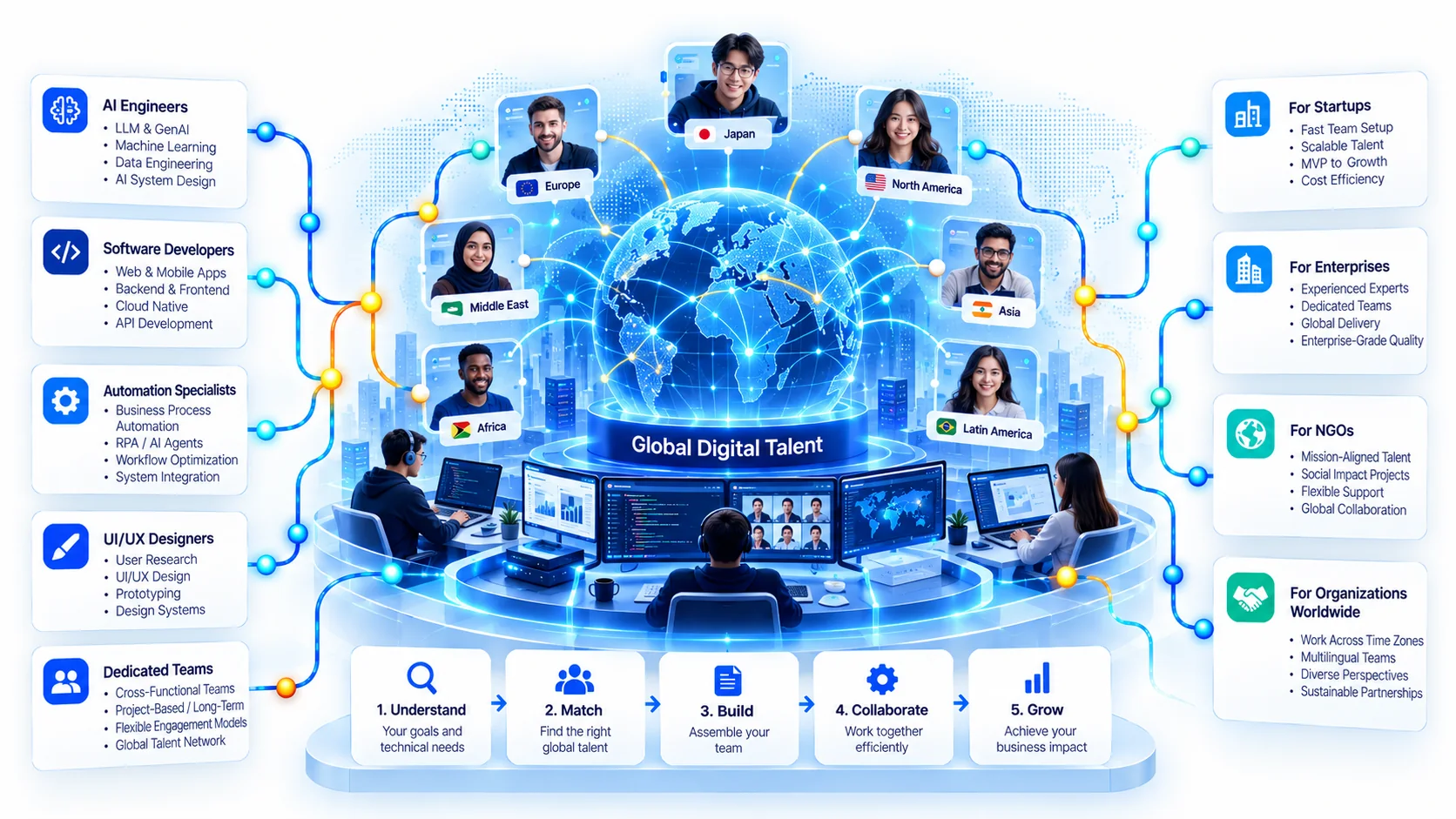
By agreeing the overlap before anyone starts: which hours are shared, which decisions can wait for them, and which cannot. Distributed work fails in the hours when nobody is awake at the same time, not in the hours when everyone is. The regions and portraits in the illustration at the top of the page are illustrative, not a map of where our people are based.
Eventually someone always does, which is why the knowledge is written down as the work goes rather than at the end. Replacing a person starts from the gap as it stands then, not from the old role description - the team has usually moved on since.
That depends on the role, and on your side more than you might expect: access, a first task and someone to answer questions decide how soon a new person becomes useful. We will not quote a start date before we understand the gap, and a fast start without onboarding is usually slower than a considered one.
Next
Tell us what your team cannot do yet, or cannot do fast enough, and what that is costing you. We will come back with whether it is a people problem at all, what kind of person or team would close it, and how they would fit the way you already work.
Related white papers and articles for Global Digital Talent will appear here as they're published.
View MoreGet in touch and we'll help you find the right approach.
Talk to Us